
 中文
Xerox has spent the last couple of years being asked a question it clearly did not enjoy answering: are you still in commercial print?
The evidence for the prosecution was not thin. The company stopped making its high-volume iGen5 and Nuvera digital presses. Then it went and acquired Lexmark, a move that reads to a lot of people as a pivot toward office and IT services rather than sheet-fed production. Every trade show conversation ended up in the same place — is Xerox leaving the press business, or just leaving the parts of it that do not make money?
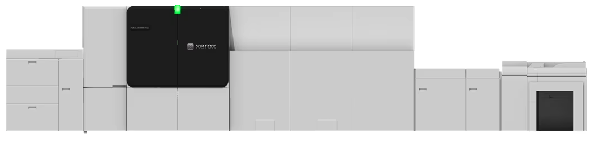
This week’s answer is a machine. The Xerox Proficio Jet CS1100, a B3 cut-sheet inkjet press running at up to 300 A4 images per minute.
The spec sheet, and why it matters
A B3 cut-sheet inkjet press at 300 images a minute is a serious piece of kit. But the details are where the intent shows.
It uses new Xerox-developed proprietary printheads — not bought-in heads from a third party, but its own. The ink formulation is described as high-definition, delivering 1,200 by 1,200 dpi with 2-bit variable-drop imaging. That combination is aimed at precise dot placement, smoother coverage, finer lines and — the phrase that gives the game away — crisper small text and knockouts.
Small text and knockouts. That is not transactional language. That is the language of people who print pharmaceutical cartons, instruction leaflets, financial reports and brand collateral, where a ragged six-point line is a defect, not a nuance.
There is also a scalable drying architecture that supports media up to 350 gsm, including coated stocks. Coated stock support matters enormously in the real world, because the moment a press cannot handle coated paper it is a niche machine. Every commercial printer’s sample drawer is full of coated work.
Xerox positions the press across transactional and direct mail, graphic communications and commercial print. That is a wide net, and it is deliberate.
Why B3, why now
The choice of B3 cut-sheet is the most interesting decision in the whole announcement.
B3 is the size that fits the work that has actually been growing: short-run brochures, personalised direct mail, book blocks, point-of-sale, small-format packaging and the endless middle ground of commercial print that is too short for offset and too long for a sheet-fed toner box to be comfortable.
For years, the industry’s answer to that middle ground was toner. Toner is superb at short runs and superb at quality, and it has been steadily losing the argument on cost per page as inkjet improved. What inkjet needed was to get good enough on coated stock and on fine detail to take the quality argument away from toner.
That is exactly what a 1,200 dpi, 2-bit variable-drop head on coated stock to 350 gsm is designed to do.
The commercial context nobody should ignore
Here is the part Xerox will not say out loud, and which every printer should think about anyway.
The market this press is aimed at is shrinking in volume and fragmenting in job size. Fewer long runs, more versions, more personalisation, tighter deadlines, and customers who have been trained by e-commerce to expect next-day delivery on a 200-piece order.
A press that runs 300 A4 images a minute is not really about throughput. It is about being able to say yes to a job at four in the afternoon that has to ship tomorrow morning, at a cost that still leaves a margin. That is the actual competitive requirement in 2026, and it is why the drying and substrate support matter as much as the speed number.
What to ask before you get excited
If you are a printer looking at this, the questions that decide whether it works for you are boringly practical.
What is the real cost per sheet on the coated stocks you actually buy, not the ones in the demo? What is the duty cycle, and what does the service contract look like at 300 images a minute running two shifts? How does it handle the mixed stocks in a typical day — a run of 350 gsm board followed by 90 gsm uncoated — without a lengthy recalibration? What is the front-end workflow, and does it talk to the MIS you already own? And, most importantly, what happens to your click or service cost when the volume you forecast does not arrive in year one?
Those questions are not cynicism. They are the difference between buying a capability and buying a showroom.
The bigger picture
For the wider industry, the significance is simpler than any of the specs. A major vendor has just put real money behind a new production inkjet platform aimed squarely at commercial print, at the moment when a lot of people had written that market off as a slow decline into irrelevance.
That does not mean the decline is not happening. It means somebody with a balance sheet has decided the remaining business is worth competing for, and that the way to win it is quality on coated stock at speed, in a format that suits the job sizes customers now order.
Whether Xerox can rebuild trust with a commercial print base that has spent two years wondering about its commitment is a different question, and one no press launch answers. But it is a great deal easier to have that conversation with a machine on the floor than with a press release.
Source: PrintCAN — Xerox Introduces Proficio Jet CS1100