
 中文
Annual reporting season rarely makes headlines, but Ricoh’s 2026 disclosure cycle deserves a closer read from anyone tracking where the imaging and print industry is heading. The company has released the English editions of its Ricoh Group Integrated Report 2026 and Ricoh Group Sustainability Report 2026, completing a trilogy with the ESG Data Book 2026 published in September. Together, the three publications map out how a legacy print and imaging manufacturer is repositioning itself around execution discipline, profitability and verifiable sustainability.
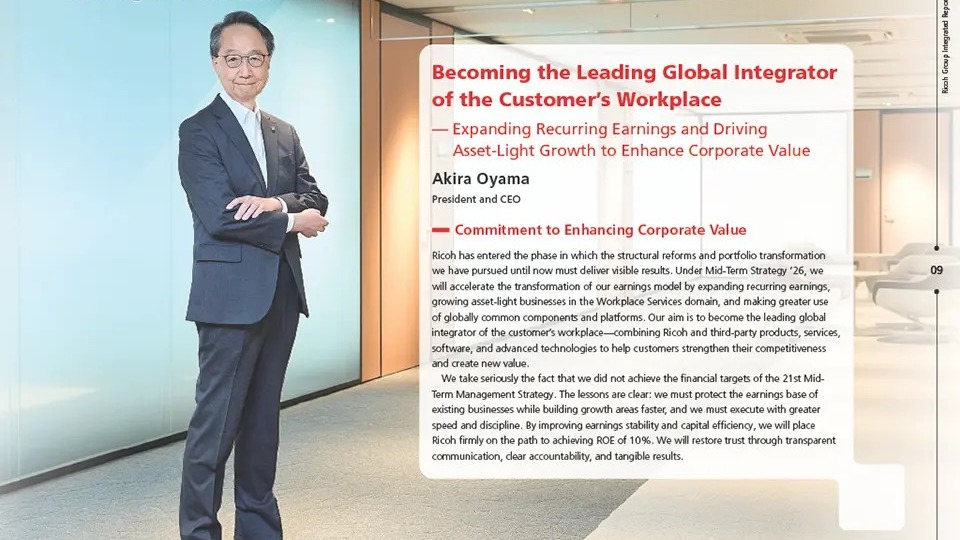
The Integrated Report marks the first full year of Mid-Term Strategy ’26, and its emphases are telling. Ricoh is prioritizing strengthening execution, improving profitability and building recurring earnings — language that will be familiar to anyone who has watched hardware-centric manufacturers grapple with the transition from box-selling to service- and subscription-driven models. The report features direct commentary from the chief executive officer, chief financial officer and chief strategy officer, laying out growth priorities and a stated objective of achieving return on equity above 10 percent.
That ROE target is more than an investor-relations flourish. For a company whose share of recurring revenue determines valuation multiples in the modern office-services market, the shift toward predictable earnings streams — managed print services, cloud workflow, hybrid work solutions — is the strategic story of the decade. The 2026 report also introduces a more integrated presentation of regional and business strategies under Ricoh’s new matrix management structure, explicitly connecting operational priorities with the company’s broader value-creation objectives. Matrix management is notoriously hard to get right, but for a global company selling across dozens of markets with very different print-IT maturity, it is a rational response to fragmentation.
The Sustainability Report 2026 expands Ricoh’s disclosures on environmental, social and governance initiatives, and its framing is notably pragmatic: sustainability activities are presented as supports for business growth and long-term corporate performance, not as a parallel moral universe. The disclosures align with international reporting frameworks and provide concrete examples of how ESG priorities relate to business opportunities, risks and stakeholder expectations. That framing matters for print-sector customers, who increasingly need their suppliers’ sustainability data to feed their own regulatory reporting.
Two areas of expansion stand out. First, Ricoh has broadened coverage of social initiatives, including accessibility and community engagement, in response to what the company describes as increasing customer interest. Accessibility is quietly becoming a procurement criterion for large enterprise and public-sector buyers, and vendors who can document it credibly gain a differentiator that is difficult to copy quickly. Second, the report examines the relationship between environmental and human rights considerations, describing an integrated approach to evaluating their interconnected impacts and translating those findings into practical actions. Supply-chain due diligence legislation in Europe is pushing exactly this kind of joined-up analysis, and Ricoh’s early positioning suggests it intends to be ahead of the compliance curve rather than behind it.
The accompanying ESG Data Book 2026 rounds out the package with quantitative performance information in a deliberately streamlined format. The design goal — making environmental, social and governance metrics easier for investors, analysts and other stakeholders to review — reflects a broader industry lesson: disclosure volume without comparability serves nobody. Print-industry suppliers are increasingly judged on emissions intensity, circularity metrics and social indicators by the same corporate customers who are themselves reporting under CSRD-style regimes, so clean, standardized data has become commercial infrastructure.
For the printing and packaging community, the significance of Ricoh’s reporting cycle goes beyond one company’s governance credentials. Print manufacturers sit upstream of thousands of PSPs, in-plants and converters whose own customers demand sustainability documentation. When an equipment maker like Ricoh publishes framework-aligned ESG data and integrated strategy narratives, it cascades: dealers and service partners can inherit credible numbers, PSPs can embed them in customer-facing reporting, and the whole supply chain spends less time reconstructing lifecycle claims from scratch.
The reports also reflect Ricoh’s founding principle-oriented corporate culture, a thread the company has consistently woven through its communications as it repositions from a copier manufacturer into a digital services organization. Whether the Mid-Term Strategy ’26 targets land on schedule remains to be seen, but the 2026 reporting cycle shows a company willing to commit to measurable outcomes — profitability, recurring revenue share, ROE — and to tie its sustainability narrative to the same standard of evidence. In a print industry where both strategy and ESG claims too often float free of numbers, that discipline is itself news.
There is a practical reading for print business owners buried in these documents. When an equipment giant reorients around recurring earnings, its product roadmap follows: expect more subscription-based workflow software, usage-metered services and managed offerings, and fewer one-shot hardware promotions. Buyers who understand this shift negotiate differently — they ask about five-year total cost, service-level guarantees and data portability instead of chasing the deepest discount on the box. The vendors’ reporting language today is effectively the product catalog of three years from now.
The ESG discipline also sets a marker competitors will be pressed to match. As enterprise and public-sector procurement increasingly requires audited supplier sustainability data, gaps between vendors’ disclosure quality become commercial gaps, not just reputational ones. Print service providers choosing between equipment brands should add one more line to the evaluation sheet: whose numbers can I reuse in my own customer reporting without re-engineering them? On that criterion, Ricoh’s 2026 cycle is designed to win — and it raises the bar for what the whole industry’s annual reporting season is expected to deliver.
Source: inkish.news / Ricoh Company, Ltd., “Ricoh Releases 2026 Integrated and Sustainability Reports”.


