中文
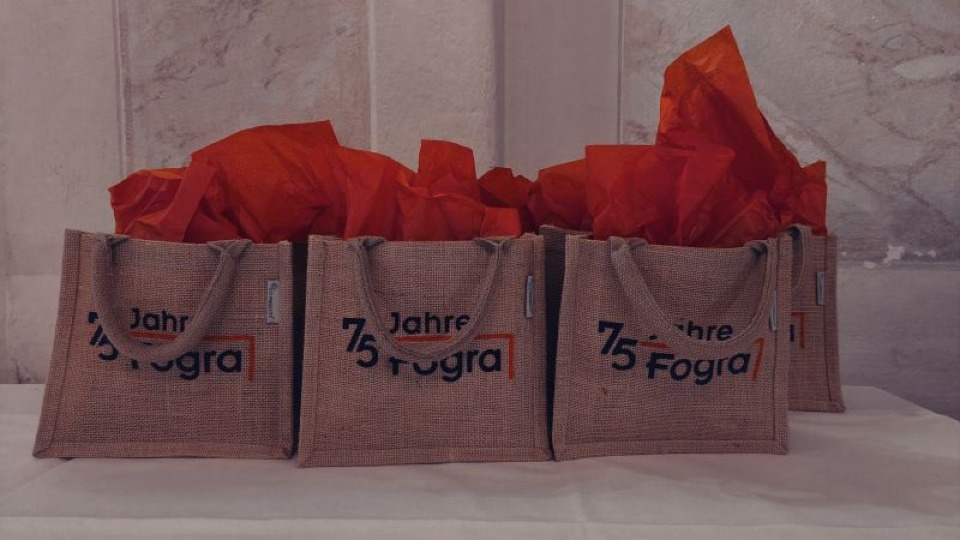
Fogra, the German research institute for the printing and media industries, celebrated its seventy-fifth anniversary on October 15, 2026, with around fifty guests gathering at Munich’s historic Bamberger Haus, the organization’s original headquarters. Founded on May 9, 1951, during the inaugural drupa exhibition in Dusseldorf, Fogra began as a nonprofit association established by twenty-five companies and individuals to advance research for the graphic arts industry at a time when the sector was rebuilding after the war.
Its earliest projects addressed practical production challenges, including masking techniques, flexible printing forms, and anti-set-off powdering, with attention to health and safety concerns decades before they became established industry priorities. Since its founding, Fogra has completed 1,236 research projects, produced 40,472 expert reports, and organized 654 training courses and symposia attended by 31,470 participants. Those activities have made the institute a reference point for scientifically grounded research, technical evaluation, and knowledge sharing across printing, work that still underpins daily quality decisions in print buying.
The anniversary returned Fogra to its first home, where it operated from 1951 until 1974 before relocating within Munich and eventually moving to its purpose-built facility in Aschheim. Guests toured the historic premises and viewed a retrospective film tracing the institute’s development across three locations, four directors, and four chairpersons. Chairman Stefan Aumuller and Managing Director Dr. Eduard Neufeld emphasized the institute’s continuity and its ability to anticipate technological change while translating research into practical industry knowledge, a balance that has kept Fogra relevant across three-quarters of a century.
Fogra’s longevity is notable in an industry that has repeatedly reinvented itself around new imaging, substrate, and connectivity technologies. The institute’s willingness to tackle unglamorous but economically vital problems, from powdering to process standardization, is a large part of why it remains respected. Its expert reports and certifications are still referenced daily in quality assurance and supplier qualification. The seventy-fifth milestone also underscores the value of independent, industry-funded research bodies. Unlike vendor-led development, Fogra’s work is oriented toward problems that affect the whole sector, not the roadmap of a single supplier, and that neutrality is what gives its standards their authority.
As printing converges with digital workflows, automation, and sustainability reporting, Fogra’s role is shifting again, toward topics like life-cycle assessment, print quality in industrial applications, and the verification of new materials. The institute’s history suggests it will continue to act as a bridge between academic research and the shop floor, a function the industry cannot easily replace. For the broader print and packaging community, the anniversary is a reminder that durable institutions are built on consistent, practical service rather than fashion, and that the quiet work of standardization is what lets a fragmented industry interoperate.
There is a lesson here for the current wave of print technology change. Much of today’s innovation arrives wrapped in marketing, and printers are asked to separate genuine advances from rebranded capabilities. Independent bodies like Fogra provide the measurement and the method that let the industry agree on what good looks like. When a new substrate, ink, or process claims a performance benefit, it is often Fogra-style testing that converts the claim into a shared fact.
The institute’s model, funded by the industry it serves and governed by representatives of that industry, also offers a template for collective action that is hard to replicate through competition alone. No single company has an incentive to maintain neutral reference data for everyone’s benefit, yet every company benefits from its existence. That is the classic case for a shared research infrastructure, and Fogra’s seventy-five years are evidence that the model can endure.
Looking forward, the challenges Fogra will confront, decarbonization accounting, digital print quality at industrial scale, and the verification of recycled and bio-based materials, are exactly the kind of cross-cutting problems that resist single-vendor solutions. The institute’s anniversary is therefore less a look back than a quiet argument for why the next seventy-five years of print will still need a neutral, practical, research-driven anchor.
Source: https://inkish.news/en/article/fogra-celebrates-75-years