中文
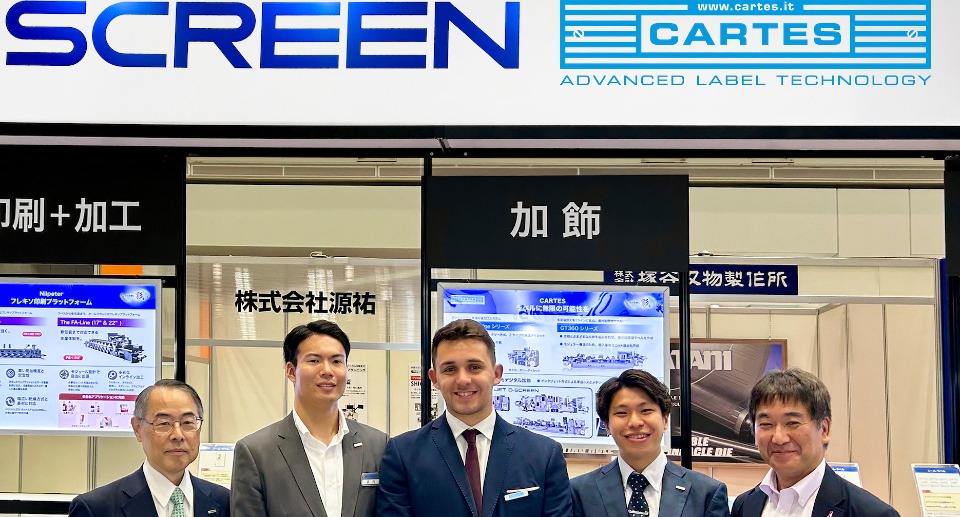
Italian label converting and finishing equipment manufacturer CARTES used its participation in Label Forum 2026, staged with local partner SCREEN GP JAPAN, to reinforce its commitment to the Japanese market. The event gave CARTES a platform to demonstrate how its finishing and embellishment technology can help Japanese label converters move into higher-value applications and expand their production capabilities at a time when plain label capacity is increasingly commoditized.
Japan has long been one of the world’s most demanding print markets, with converters oriented toward precision, short runs, and premium quality. CARTES’ portfolio, which spans digital and conventional finishing, laser cutting, and specialty effects, is positioned to address exactly those expectations. By working through SCREEN GP JAPAN, the company gains an established local channel with the service infrastructure and customer relationships needed to support sophisticated finishing installations, an arrangement that reduces the risk for Japanese printers adopting unfamiliar equipment.
The collaboration highlights a wider trend in the label industry: as brand owners request more decorative and functional labels, converters must invest in finishing technology that differentiates their output. Embellishment, tactile effects, and variable decoration are no longer optional extras but routes to margin in a market where standard die-cutting is contested on price. CARTES’ presence at Label Forum 2026 signals that the Italian manufacturer views Japan not as a peripheral market but as a strategic one where precision engineering meets premium demand. For Japanese converters, the partnership pairs foreign engineering with a familiar domestic supplier, often a decisive factor in capital equipment decisions where responsiveness and local support weigh heavily.
The emphasis on higher-value applications also reflects structural pressure on label margins globally. Converters that can offer integrated decoration, security features, and rapid changeover are better insulated from price competition than those limited to commodity finishing. By showcasing a connected portfolio of laser, digital, and conventional finishing, CARTES is arguing that the future of the Japanese label sector belongs to converters who can combine multiple effects on a single, automated platform. Looking ahead, that ability will likely define competitive positioning, and partnerships like this one lower the barrier for converters considering the step up from basic to value-added production.
There is a second dynamic worth noting. Japanese label converters have historically been early adopters of automation and quality systems, which makes them natural candidates for the kind of integrated finishing CARTES promotes. But they are also conservative buyers who prefer proven local support. The SCREEN GP JAPAN channel resolves that tension by wrapping Italian technology in domestic service capability, a template other foreign equipment makers have used successfully in the market.
For CARTES, the move is part of a broader internationalization. Italian finishing specialist suppliers have been especially active in Asia as the region’s label consumption grows and brand owners regionalize their packaging. Japan, with its mature brand landscape and exacting quality bars, is a proving ground: success there lends credibility elsewhere in Asia.
The label industry’s shift toward embellishment is also a response to digital printing’s erosion of traditional print volume advantages. When a label can be produced digitally with minimal setup, the differentiator shifts to what is done after printing. Finishing and decoration, where CARTES concentrates, become the value-adding layer that justifies premium pricing. In that sense, the company’s Japanese push is aligned with where margin is migrating in the global label business.