 中文
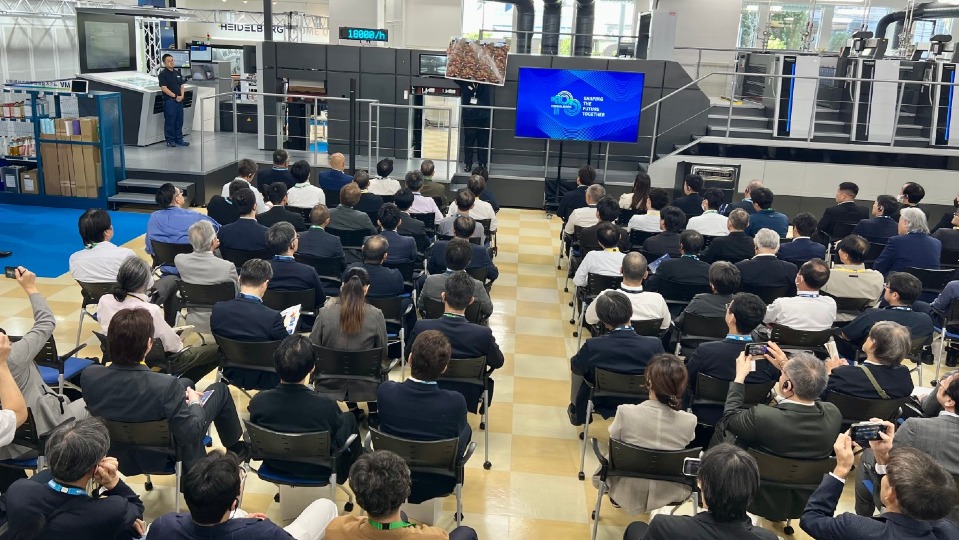
HEIDELBERG is marking a century of operations in Japan with the world premiere of a new double delivery system for its Speedmaster XL 106 sheetfed offset press. Introduced at the company’s Japanese showroom, the technology was developed largely in response to customer requirements for greater quality assurance, production efficiency, and process reliability. The double delivery automatically separates acceptable printed sheets from those requiring additional inspection, creating two dedicated delivery stacks instead of one mixed pile.
This allows production-ready sheets to proceed directly to finishing, while quality-critical sheets can be evaluated and potentially reused, reducing manual sorting and material waste. The system is particularly relevant to high-value packaging, pharmaceutical, security, and trading card applications, where even minor printing defects can create high downstream costs. HEIDELBERG reports that the first systems have already been sold to customers in Japan and Europe, a sign that the feature addresses a shared need rather than a regional preference.
The introduction reflects the importance of Japan as both a major market and a source of technological development for HEIDELBERG. The company has operated in Japan since 1926, and the country consistently ranks among its five largest markets worldwide. Japanese printers’ emphasis on precision, automation, and zero-defect manufacturing has influenced the development of equipment designed to deliver consistent quality while minimizing operator intervention, and the double delivery is a direct product of that feedback loop.
Dr. David Schmedding, Chief Technology and Sales Officer at HEIDELBERG, said the new double delivery shows how the company translates customer requirements into product innovations while expanding its role as a systems integrator across the packaging production value chain. Jorg Bauer, President of HEIDELBERG Japan, described introducing the technology during the anniversary celebration as a continuation of the company’s long commitment to Japanese printers and packaging manufacturers, binding a centennial milestone to a concrete capability rather than a commemorative gesture.
The double delivery concept speaks directly to a persistent pain point in high-value printing: the cost of a single defective sheet discovered late in the process. By physically separating suspect sheets at the press, HEIDELBERG removes a manual inspection bottleneck and reduces the risk that flawed material flows downstream into finishing and converting, where the cost of a defect multiplies. For packaging and security printers, where brand owners tolerate almost no deviation, this kind of inline assurance is increasingly decisive in equipment selection. As HEIDELBERG enters its second century in Japan, the launch neatly ties the company’s heritage of precision engineering to the automation demands of modern packaging production.
The commercial logic of the double delivery is worth unpacking. In pharmaceutical and security printing, a rejected sheet is not merely wasted substrate; it is a break in a controlled, often serialized production chain where traceability matters. Separating good from suspect at the point of printing preserves the integrity of the good stack and simplifies the investigation of the suspect one. That has compliance value, not just efficiency value.
It also reflects a broader shift in press design from maximizing raw speed toward maximizing usable output. A press that runs fast but delivers a mixed pile still pushes the sorting burden onto people, and people are the most expensive and error-prone part of the line. By automating the separation, HEIDELBERG lets a single operator manage more of the process, which aligns with the industry’s labor and zero-defect pressures simultaneously.
For HEIDELBERG, the Japan centennial is more than nostalgia. The market has been a reliable top-five source of demand and a demanding test bed for features that later travel globally. Launching a premium, quality-assurance-oriented innovation there is a calculated move to cement relationships with customers whose standards influence the rest of the Asia-Pacific region. The Speedmaster XL 106 double delivery, in short, is both an anniversary statement and a bet on where packaging print is heading: less tolerance for defects, more automation at the point of production.