
 中文
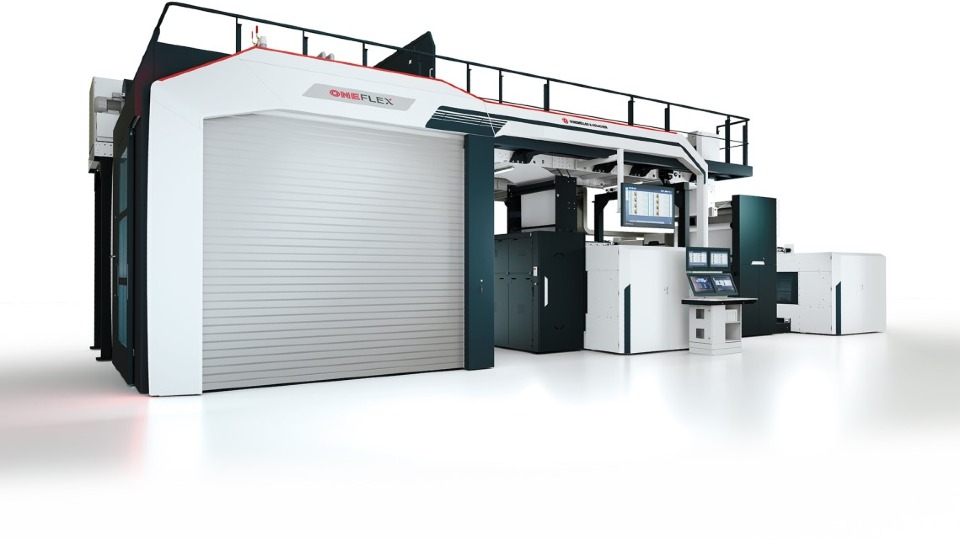
Windmöller & Hölscher has expanded its flexible packaging printing portfolio with the launch of ONEFLEX, a new central-impression (CI) flexographic press built around modularity, production efficiency and operator accessibility. The German engineering group, long associated with high-end flexo and extrusion systems, is positioning ONEFLEX as a more attainable entry into its CI flexo technology without sacrificing the stability and print quality the brand is known for.
The platform is anchored by a newly engineered print deck designed to hold consistent quality at production speeds up to 600 metres per minute, with printing widths reaching 1,650 millimetres. Available in eight- or ten-colour configurations, ONEFLEX brings a wider format range to a segment previously served mainly by W&H’s premium press lines. That wider format lets converters handle more demanding flexible-packaging jobs, from high-colour-count pouches to multilayer films, on a single platform.
A modular architecture sits at the heart of the design. Rather than locking buyers into a fixed specification, ONEFLEX lets converters configure the equipment around their actual production requirements while leaving room to accommodate changing packaging applications and shifting market demands. For a converter weighing its first CI flexo investment or looking to add capacity, that flexibility protects the capital decision against future uncertainty.
Holger Kreilkamp, Director of Product Management at W&H, said the development brings together established CI flexo technology with a new print deck and an operator-focused design intended to improve daily production performance. The emphasis on the operator reflects a broader industry preoccupation: as print decks grow more automated and substrate ranges broaden, the bottleneck is increasingly the people running the machines. A press that is easier to set up, access and maintain translates directly into less downtime and less waste.
Safety and accessibility receive particular attention. W&H describes ONEFLEX as its safest CI flexographic press to date, incorporating advanced safety features, improved machine accessibility and an operator-oriented layout. The redesigned print deck supports stable quality at high speeds, while simplified handling and better access to components make routine tasks such as anilox changes, cleaning and web threading far less time-consuming. These are the unglamorous details that, in daily operation, decide whether a press lives up to its specification sheet.
For converters that need more, W&H is also introducing ONEFLEX Ultimate, a premium configuration capable of production speeds up to 700 metres per minute. The Ultimate variant pushes throughput further while retaining the same operator-centred philosophy, giving high-volume flexible-packaging producers a clear upgrade path within the same family.
The launch arrives at a moment when flexible packaging continues to grow faster than many other print segments. Food, pet food, pharmaceutical and consumer-goods pouches all demand high-quality, high-speed decoration, and converters are under pressure to deliver shorter runs, faster changeovers and verifiable sustainability. A modular CI flexo platform that is both capable and approachable speaks directly to that tension.
There is also a service dimension that should not be overlooked. W&H’s installed base and service organisation mean that ONEFLEX buyers inherit a mature support structure, which matters for shops running around the clock. Local spares, commissioning and training reduce the risk that a sophisticated press becomes a liability during ramp-up.
For the wider market, ONEFLEX signals that the leading flexo suppliers are broadening their portfolios downward, offering aspirational technology at a more attainable entry point. That trend compresses the gap between premium and mid-range CI flexo, giving smaller converters access to capabilities that were once the preserve of large integrated packaging groups. It also intensifies competition for press makers that have traditionally owned the value segment.
The practical takeaway for converters is that the CI flexo decision is no longer simply a choice between a premium line and a budget line. Modular platforms like ONEFLEX let buyers pay for the capability they actually need today and expand as work evolves. Done well, that approach aligns capital spending with real demand rather than with a sales pitch.
W&H’s move also reinforces a theme running through the whole flexo sector: the future belongs to presses that combine industrial productivity with genuine usability. As skilled operators become harder to find and retain, the vendors that design around the people on the floor, not just the numbers on the brochure, will be the ones converters trust with their next investment.
Source: Windmöller & Hölscher via inkish.news


