中文
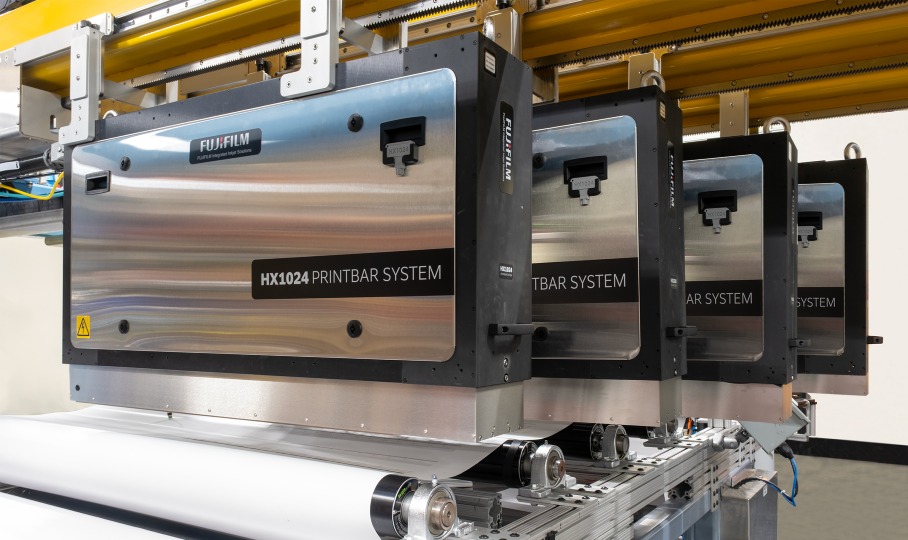
FUJIFILM Integrated Inkjet Solutions has launched the HX1024 Printbar System, a drop-in inkjet module designed to help construction-product manufacturers add customised, on-demand printing to materials including house wrap, sandpaper, drywall and laminates. Rather than asking factories to rebuild a production line around printing, Fujifilm has packaged the technology as a printbar that mounts into existing processes, printing variable content at speed without becoming the bottleneck.
Available in 30-inch and 40-inch widths, the system prints at 400 dpi in a single pass at speeds up to 500 feet per minute. LED-curable UV inks and LED lamps are intended to reduce heat and energy use compared with mercury-based curing, an increasingly important consideration for manufacturers watching both utility bills and emissions. Workflow options range from a simplified TIFF printing mode to a full digital front end with expanded file support, production workflow management, colour management and an integrated RIP.
Ankur Mour, vice president and general manager of FUJIFILM Integrated Inkjet Solutions, said the HX1024 Printbar System was developed to make on-demand printing on these materials as easy and efficient as possible. That ease is the whole point: construction-product makers are manufacturers first and printers a distant second, so any printing step has to be rugged, self-monitoring and unobtrusive. The system features liquid-cooled electronics, built-in health checks and accessible maintenance points, while top, side or bottom mounting configurations let it integrate into challenging production environments.
The appeal of printing directly on construction materials is twofold. First, it allows variable information, branding, instructions or regulatory marks to be applied without separate labelling or preprinted inventory. A roll of house wrap or a sheet of drywall can carry batch codes, safety guidance or distributor branding as it is made, eliminating a downstream step and the stock-keeping complexity that comes with preprinted variants. Second, it turns a commodity material into a lightly customised one, opening service and margin opportunities for manufacturers and distributors.
The industrial inkjet market has matured to the point where printbars are a recognised way to retrofit intelligence onto analogue lines. Fujifilm’s HX1024 printhead family is already established in demanding graphics and industrial applications, and packaging the heads into a supported, mountable system lowers the integration risk for manufacturers who have no in-house inkjet expertise. Built-in health checks and accessible maintenance mean that when something does need attention, it can be resolved quickly by existing line staff.
Energy efficiency deserves emphasis. Mercury vapour curing has long been effective but carries environmental and workplace baggage, and LED-UV curing addresses both while generating less heat, a real advantage when printing on temperature-sensitive substrates such as certain laminates and films. Lower heat also protects the material and the printbar itself, improving uptime.
For the broader industrial printing sector, the launch is another sign that inkjet is moving off the exhibit floor and into factories that never thought of themselves as printers. As the cost and complexity of integration fall, more product manufacturers will treat variable printing as a standard line capability rather than a specialist service, reshaping how everything from building materials to consumer goods are marked, branded and tracked.
Fujifilm’s move also reflects a strategic tilt toward selling printing as infrastructure, embedded and invisible, rather than as a standalone machine. For manufacturers, that means the benefits of digital printing, such as versioning and traceability, without the organisational upheaval of standing up a print operation. The HX1024 Printbar is a small module with a fairly large implication: the factory floor is becoming a print surface.
Source: Fujifilm via inkish.news