 中文
Gallus Group has taken one of its most consequential product decisions in years: a brand-new flexographic press platform, the Gallus Flexomaster, engineered for global standards but assembled locally in India for the country’s fast-growing label and packaging converting community. Unveiled at LOUPE India 2026, the launch signals how leading press manufacturers are rethinking what “market-specific” really means when emerging economies become the primary engine of volume growth.
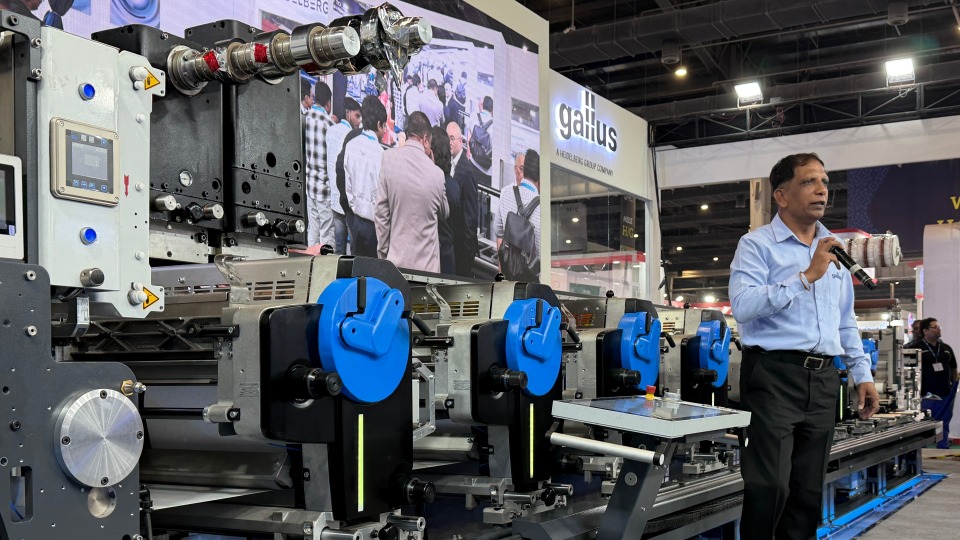
At its core, the Flexomaster is a narrow-web flexo platform built around a 440 mm printing width and production speeds of up to 200 m/min. The configuration is deliberately expandable, supporting up to twelve printing and processing stations, so a converter can start with a sensible baseline and grow into a far more capable line without replacing the core machine. That modular logic extends to the process mix as well: the press combines flexographic and screen printing units with optional cold foil, lamination and web-turning capabilities.
What makes the Flexomaster genuinely interesting is the breadth of applications it is designed to serve out of the box. Gallus positions it for pressure-sensitive labels, shrink sleeves and in-mold labels, along with selected flexible packaging work such as sachets and pouches. For a mid-sized Indian converter juggling brand customers across food, personal care, pharmaceuticals and household goods, that is a single platform able to carry a very large share of the order book.
Samir Patkar, President of HEIDELBERG India, framed the value proposition in refreshingly blunt terms: converters need technology aligned with the realities of their businesses, from investment and operating costs to the applications they actually produce every day. It is a statement that acknowledges what many in the industry have said privately for years — that flagship European press platforms, however capable, often overshoot the price-performance envelope of high-growth but cost-sensitive markets.
The decision to assemble the press locally in India is more than a logistics footnote. Local assembly typically shortens delivery times, reduces import duties on the finished machine, and — critically for uptime-sensitive label shops — places service and spare parts much closer to the customer. The Flexomaster is supported by HEIDELBERG’s established Indian sales and service network, which plugs the new platform into a broader ecosystem of conventional, hybrid and digital printing technologies, workflow software and technical support.
That ecosystem argument matters. Label converters today rarely buy a press in isolation; they buy into workflow automation, prepress integration, finishing modules and a service relationship that will span a decade. By anchoring the Flexomaster inside the Gallus and HEIDELBERG portfolio, the group is effectively offering Indian converters a ladder: enter with an affordable flexo workhorse, then adopt digital label production, advanced workflow tools and premium embellishment as their business matures.
LOUPE India 2026 also served as the regional debut of the Gallus Screeny Printing Unit, a screen printing module that can be integrated into existing narrow-web presses regardless of manufacturer. That open-architecture approach is notable in itself — rather than fencing converters into the Gallus ecosystem, the company is selling the upgrade path to everyone, including presses it did not build. Screen units of this kind open the door to high-build varnish, tactile effects and specialty inks, the embellishment categories where converters capture their healthiest margins.
The commercial sequencing is equally deliberate. Initial installations in India are planned throughout 2027, after which Gallus intends to introduce the Flexomaster into selected international markets with similar production requirements. That phrasing — “similar production requirements” — is a quiet acknowledgment that India is not the only market where price-performance pressure and application breadth define success. Converters across Southeast Asia, the Middle East, Africa and Latin America face comparable economics, and a platform validated in one of the world’s most demanding price markets arrives elsewhere with credibility attached.
For the Indian label industry specifically, the timing is hard to argue with. Organized retail, e-commerce packaging, regulatory labeling requirements and brand proliferation continue to push demand upward, while the converter base professionalizes rapidly. Many of the country’s mid-market shops have already invested once in used or entry-level equipment and are now at the point where reliability, automation and finishing capability determine whether they can hold blue-chip accounts.
The Flexomaster will not be the only press chasing that opportunity — established competitors have served the region for years, and Chinese press makers are increasingly aggressive on price. But a locally assembled platform from an established European manufacturer, backed by an on-the-ground service organization and a portfolio that spans flexo to digital, changes the shape of the conversation. Indian converters no longer have to choose between capability and affordability; the industry’s biggest names are now building for that middle ground, and the Flexomaster is the clearest evidence yet.
There is a practical checklist hiding inside this launch for converters outside India, too. If you are evaluating a narrow-web platform in any growth market, the questions the Flexomaster raises are the right ones: can the machine grow station by station instead of being replaced? Does the supplier assemble, service and stock spares within your own borders? Can one platform genuinely cover labels, sleeves and selected flexible work so your operators master a single architecture? Converters who ask those three questions consistently end up with presses that hold utilization through downturns instead of becoming expensive shelf ornaments.
The embellishment angle deserves a final word, because margins in labels increasingly live in the finish rather than the ink. A base flexo line that can add screen, cold foil and lamination in modular steps lets a shop sell tactile, premium decoration to brand customers long before it can justify a dedicated premium press. That is exactly how the mid-market closes the gap with the big houses — one upgrade at a time, on a machine that was designed to accept them. Watch how the 2027 Indian installations perform; their economics will decide whether locally assembled, modular flexo becomes the template for every other emerging label market this decade.
Source: inkish.news / Gallus Group, “Gallus Launches Flexomaster Label Press for Indian Market” (LOUPE India 2026).