
 中文
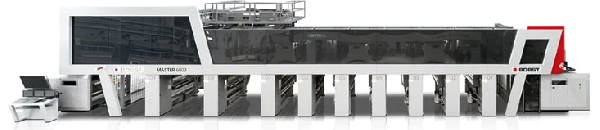
Gravure has an image problem, and it is not about quality. Everyone knows gravure prints beautifully. The problem is that a gravure press is a machine that only makes financial sense if you keep it running — long jobs, stable SKUs, the same design for weeks.
Which is precisely the thing the packaging market stopped giving anybody.
That is the context you need to understand what BOBST announced this week. The Swiss equipment maker has introduced the MASTER 6003, the latest evolution of its MASTER gravure platform, and the headline numbers are about ink and solvent rather than speed. An enhanced inking system reduces the ink required in circulation to print by 60 percent. That cuts solvent consumption by up to 40 percent.
Those are not vanity figures. They are a direct answer to the economics of a market where run lengths keep shortening.
Why ink in circulation is a real cost
Here is the thing non-printers never quite grasp: a gravure press does not use ink the way a car uses petrol. It holds a reservoir of ink in circulation — in tanks, in pipework, in the pan — and that ink has to be maintained, viscosity-controlled and, in solvent-based systems, constantly topped up with solvent to replace what evaporates.
So a press that needs 60 percent less ink sitting in circulation is not just buying less ink. It is evaporating less solvent, disposing of less waste, cleaning less, and spending less time bringing a job on. On a long run, that is a rounding error. On a three-day run that changes over twice, it is the margin.
The company’s own framing is blunt about this. The MASTER 6003’s LeanPrint inking system is designed, in BOBST’s words, to protect margins in response to run lengths shortening across the packaging sector.
The engineering, briefly
The improvements are not exotic. They are the kind of thing that only shows up when someone goes through a press and asks why every single component is the shape it is.
The path from ink tank to pan has been optimised, along with the pipework design. That lets the pan position itself more quickly and precisely relative to the cylinder. The practical effect is more consistent, more controlled ink transfer at high speed without an operator standing there adjusting by hand.
There is also an automated cylinder engraving and pre-washing system at each unit. That removes a manual cleaning step — specifically, it removes dried ink from the engraved cells — which is what allows ink transfer to stay clean and consistent across a long shift. Anyone who has watched a printer fight a dirty cylinder at two in the morning will understand why this matters more than the brochure suggests.
The strategic read
BOBST employs more than 5,600 people and supplies substrate processing, printing and converting equipment to the label, flexible packaging, folding carton and corrugated board industries. It is not a company that launches a press on a whim, and it is not a company that would spend its announcement on ink savings if its customers were still buying long-run work.
The signal is this: the equipment industry now believes the shortening of run lengths is permanent. Not a cycle, not a post-pandemic blip. Permanent. And it is designing machines that make money at the job sizes the market actually offers.
This has consequences well beyond one press launch.
For converters, the calculation on gravure versus digital versus flexo gets more interesting. If a gravure press can be brought on faster, waste less and run a shorter job without destroying margin, then a whole tier of work that migrated to digital on the grounds of run length might come back. Not all of it. But the boundary moves, and the boundary is where the money is.
For brand owners, it means the supply base for short-run gravure work is likely to get deeper, which is good news if you have been paying a premium for flexibility.
For the people who specify packaging, it means the assumption that “short run equals digital” deserves revisiting. Digital wins on changeover and on versioning. Gravure still wins on ink cost per square metre and on the quality of large solid areas. If the changeover penalty shrinks, the crossover point moves.
The uncomfortable part
None of this fixes the deeper problem, which is that a capital-intensive press still needs capital. A converter looking at a new gravure line in 2026 is making a bet on a market where tariffs are moving, material costs are volatile, and customers want smaller orders with more versions and faster turnarounds.
Machines like the MASTER 6003 make that bet slightly less frightening, because they reduce the cost of being wrong about a run. They do not remove it.
What they do is draw a line under an old argument. For twenty years the industry has debated whether digital would eat gravure. The more useful question now is which work actually belongs on which process once every process has been forced to get better at short runs. BOBST has just moved gravure’s answer forward a step.
The converters who will do well out of this are the ones who re-run their cost models rather than their opinions.
Source: PrintCAN — BOBST New MASTER 6003 Gravure Press