中文
Horizon International and Konica Minolta have announced a business collaboration agreement aimed at making print manufacturing environments more connected and more automated, integrating their respective workflow technologies so that job information flows seamlessly from the press to the postpress department. The partnership links Konica Minolta’s AccurioPro Flux production printing software with Horizon’s iCE LiNK bookbinding workflow platform, enabling job information, imposition data, production status and finishing instructions to move between printing and postpress operations without manual re-entry.
The technical underpinnings are worth examining. AccurioPro Flux provides prepress preparation, imposition, job management and production tracking — the brain that plans and monitors a print job. Horizon’s iCE LiNK connects finishing equipment and manages production information using standardized data formats such as JDF, the long-promised language of print automation. By exchanging information between the two, the companies intend to automate downstream preparation and reduce the manual coordination traditionally required between press operators and finishing departments. In practice, that means a job’s finishing requirements travel with the job instead of being rekeyed, misread or discovered late.
The collaboration addresses three pressures that几乎 every print operation now feels: shorter print runs, more frequent job changes and a shortage of skilled production personnel. As batch sizes shrink and changeover frequency rises, the cost of manual handoffs between stages climbs. Every time a human must interpret a job ticket and reconfigure a finisher, time is lost and errors creep in. Tighter software integration attacks exactly that friction.
Notably, the partnership extends beyond software into physical material movement. Horizon’s autonomous mobile robots (AMRs) and hand lifters will be evaluated alongside Konica Minolta’s LS-507 high-capacity stacker to move printed output from digital presses to finishing equipment based on job completion and production status. This is a meaningful step toward lights-out production: finishing systems could prepare for incoming jobs before printing is even complete, and printed piles could travel between stages without anyone pushing a cart. The vision is a production floor where information and materials both flow automatically.
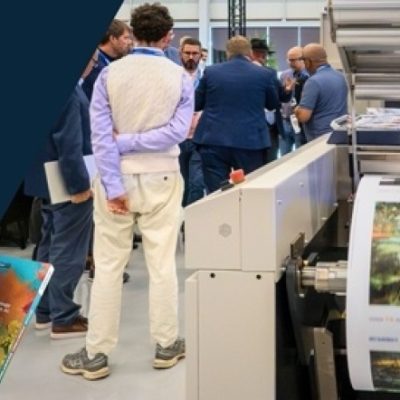
The companies will demonstrate the technology at Horizon Smart Factory 2026, scheduled for November 4–6 at Horizon Innovation Park in Takashima, Japan. The showcase will use Konica Minolta’s AccurioPress C14010S with AccurioPro Flux and Horizon’s iCE LiNK with associated postpress equipment, along with a printer-inline robotic perfect binding demonstration. Live demonstrations matter in this market because automation claims are easy to make and hard to trust without seeing the handoff actually work.
For the industry, the Horizon–Konica Minolta agreement is a data point in a larger trend: the center of gravity in print productivity is shifting from the press engine itself to the orchestration layer around it. A fast digital press is necessary but not sufficient; its value is capped if finished product still requires manual choreography. Vendors that can deliver a coherent, connected workflow — from prepress through finishing and material transport — are positioning themselves as solution providers rather than equipment sellers.
There is also a labor-market angle. With experienced finishers retiring faster than they are replaced, automation that encodes expertise into software and robotics is less about cutting headcount than about preserving capability. A connected workflow can guide less-experienced operators through complex jobs, reducing the training burden and the risk of costly mistakes.
The agreement is a collaboration rather than a merger, and that is telling. In an industry wary of lock-in, partnerships that link best-of-breed systems through open standards like JDF are more palatable than proprietary silos. If the demonstration at Smart Factory 2026 lands, it could accelerate a broader move toward autonomous, software-defined print manufacturing — where the machine that prints and the machine that binds finally speak the same language.
Source: Horizon / Konica Minolta via INKISH.
The significance of the partnership extends to how printers should think about return on investment. Traditionally, finishing equipment was evaluated on its own throughput and capability; the press was a separate capital decision. Connected workflows blur that boundary, because the value of a fast press is partly realized only when the finisher can keep pace, and vice versa. Horizon and Konica Minolta are effectively asking customers to value the system as a whole — a harder sale, but one that aligns incentives with the reality of modern, short-run, high-mix production.
For smaller print operations, the open-standards approach is especially welcome. Proprietary automation ecosystems risk stranding mid-sized printers in vendor lock-in they cannot afford. By building on JDF and REST-style integration, the Horizon–Konica Minolta link leaves room for other partners and future upgrades, lowering the existential risk of betting on the wrong walled garden. If the Smart Factory demonstration proves the concept at scale, it may set an expectation that any new equipment purchase must integrate, not isolate.
For printers evaluating such partnerships, the takeaway is practical: integration is no longer optional. As job complexity grows, the cost of manual coordination between press and finisher becomes the dominant constraint on throughput. Workflow links like this one convert that hidden cost into measurable, automatable efficiency — the real prize for any operation chasing higher utilization.