 中文
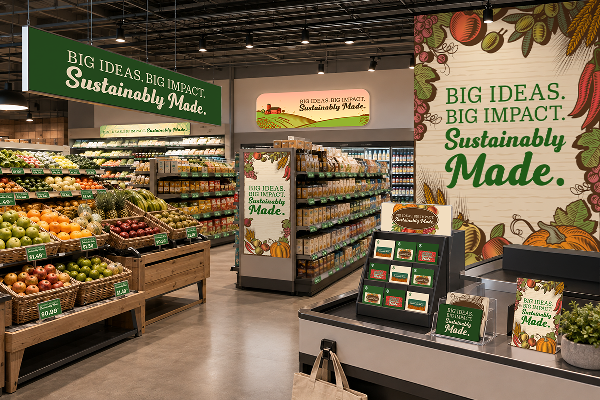
Walk through any supermarket and count the plastic. Not the products, the advertising. Shelf talkers, floor graphics, hanging displays, illuminated promos, loyalty cards, department signage. Most of it is printed on plastic, PVC foam board or styrene, because those substrates are cheap, stiff and forgiving to print on. And most of it lives in the store for a few weeks before it is ripped down and thrown away.
A company founded in 1819 wants to change that arithmetic. Monadnock Paper Mills, based in Bennington, New Hampshire, is spotlighting its Un-Plastic portfolio of performance papers for grocery store signage, and the pitch is exactly what the name suggests: fiber-based alternatives to plastic, PVC and styrene for signage, displays, wall graphics, shelf communication, tags, illuminated promotions and customer card programs.
Built for an environment that never sits still
Grocery is arguably the most brutal environment in all of retail print. Weekly specials change. Seasonal campaigns roll in and out. New product launches demand instant shelf presence, and department updates never stop coming. A signage substrate for grocery has to survive high-volume printing, fast turnaround, in-store handling, humidity near the produce section, and the general chaos of a store that is being restocked while customers walk through it.
That is the target Monadnock is aiming at with the featured products in the portfolio: Ultrahide PC 100 Blockout Poster for opaque poster work, ENVIsual Board for rigid display applications, Envi Wallgraphics for large-format wall coverage, Envi Durable Tag for tags that need to survive handling, Ultraform Backlit Poster for illuminated lightbox signage, Compostable Card, Envi Card, and Renovo. The idea is that each application, from a backlit promo panel to a hanging wobbler, gets matched with a fiber-based material that carries the right performance, production and environmental attributes.
Why retailers are actually listening
Retailers do not switch substrates out of the goodness of their hearts. They switch when three things line up: performance parity, printability, and a sustainability story their customers care about. On the first two, the paper industry has quietly closed the gap. Modern performance papers can be printed, die-cut, folded and displayed with the equipment grocery printers already own. On the third, the momentum is unmistakable. Store-level plastic reduction targets, EPR-style regulation looming over packaging and printed materials, and shoppers who actually notice when a display is compostable rather than destined for landfill have turned fiber-based signage from a nice-to-have into a competitive differentiator.
There is also a practical angle that gets overlooked: grocery signage is high-volume, short-life print. When the substrate is fiber-based, the end-of-life story improves dramatically. Materials that can be recycled or composted with ordinary paper streams are simply easier to dispose of responsibly than PVC and styrene, which many municipal systems reject outright.
A 200-year-old mill with a modern problem to solve
There is something fitting about this coming from Monadnock. A mill that has been making paper since 1819 has survived every technological wave by moving with the market, and its Un-Plastic positioning is aimed squarely at the biggest material anxiety in retail print today. For printers and display producers serving grocery chains, the message is worth taking seriously: the specification conversations are happening now, and substrates that offer plastic-level performance with paper-level sustainability are going to win shelf space.
The next time a category manager asks what the store’s new campaign will be printed on, the answer is increasingly likely to be paper. Not because plastic signage vanished, but because a mill from 1819 gave print shops a credible reason to stop ordering it.
The economics deserve a closer look too, because the anti-plastic argument only wins when it survives a cost comparison. PVC and styrene are cheap, and they got that way through decades of mature supply chains. Fiber-based alternatives have historically carried a premium, which is exactly why they stayed confined to brands with sustainability mandates. What is changing now is scale: as mills invest in performance paper capacity and more printers build experience running it, the premium is compressing. Add the disposal cost that plastic signage quietly imposes, the bin fees, the contamination problems, the brand risk of a store full of obvious plastic waste, and the total-cost gap narrows further than the invoice suggests.
For commercial printers and display houses, the opportunity is also a skills question. Fiber substrates behave differently on press and in finishing than foam PVC does. Folding scores, weight tolerances, humidity behaviour in a produce aisle, adhesive choices for wall graphics: getting these right the first time is what separates a supplier who wins the next contract from one who burns a season’s margin on reprints. Printers who invest early in mastering the Un-Plastic style portfolio will be positioned when the specification requests start arriving, and in grocery, the first mover on a compliant, credible plastic-free display offer tends to lock in the category for years.
Source: PrintCAN, October 2026.