中文
Screen Europe brought together book printers, publishers and industry specialists for its two-day Inkjet Book Production Forum, held in Amsterdam and at its Inkjet Innovation Center in Aalsmeer on October 14–15, 2026. The event explored how digital inkjet printing, workflow automation and integrated finishing technologies are rewriting the economics of book manufacturing — and, just as importantly, how connected systems can make short runs and single-copy personalization genuinely profitable rather than merely possible.
The centerpiece of the demonstrations was Screen’s Truepress JET 560HDX high-speed inkjet press, a machine featuring a 560 mm printing width and offset-class print quality. Attendees witnessed a fully automated workflow producing finished, shipping-ready books while switching between titles and specifications without stopping production. That last point is the real story: the ability to change jobs on the fly, without halting the line, is what separates industrial inkjet book production from the stop-start logic of traditional offset.
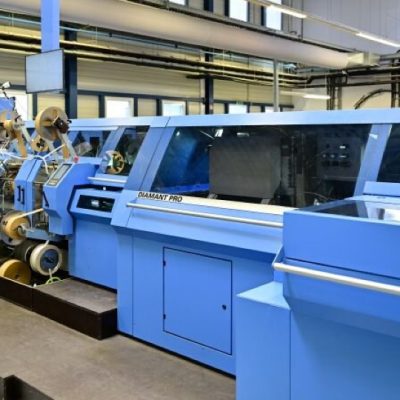
To make the case convincingly, Screen did not demonstrate a press in isolation. The forum featured technology partners Müller Martini, Horizon, MBO Komori Group, Tecnau and Matti Technology AG, highlighting how interconnected production systems can streamline book manufacturing end to end. Screen’s EQUIOS workflow software enables bidirectional communication between printing and finishing equipment, reducing manual intervention, minimizing errors and supporting greater production complexity without proportional increases in overhead or headcount.
The strategic context matters. Book manufacturing has spent years wrestling with a structural shift: readers still buy printed books in large numbers, but publishers want shorter runs, faster turnarounds and the option to personalize. Offset remains unbeatable for very long runs, yet its economics weaken sharply as batch sizes shrink and changeover frequency rises. Digital inkjet, paired with automated finishing, inverts that equation — the cost per copy stays reasonable even at a run of one, which opens doors to print-on-demand, regionalized editions and customized content that offset simply cannot serve economically.
Expert presentations and industry discussions at the forum addressed the growing demand for faster turnaround, flexible production volumes and more responsive supply chains. Those pressures are not theoretical. Publishers increasingly treat inventory as a liability, and the ability to print closer to the point of sale — or to order — reduces warehousing cost and the risk of obsolete stock. Integrated inkjet workflows are a direct response to that logistical reality.
For Screen, the forum reinforced a positioning message: inkjet is no longer a niche complement to offset but a core production technology for book manufacturing. The company’s emphasis on “connected workflows” rather than standalone speed highlights where the industry is heading. A press that prints beautifully but cannot talk to the binder, the cutter and the mailing system forces manual coordination that erodes the very efficiency digital printing promises. Closing that loop with software such as EQUIOS is what turns a collection of fast machines into a single, intelligent production line.
The presence of established finishing and postpress partners also signals consolidation of an ecosystem. Book manufacturers evaluating inkjet today are not buying a press; they are buying a pathway to a different operating model — one where capacity scales with demand, where personalization is a feature rather than a complication, and where labor is redeployed from manual handling to oversight and exception management.
As book printers across EMEA weigh capital investments, events like Screen’s forum serve a dual purpose: they demonstrate the technology and they normalize the workflow thinking around it. The demonstration of shipping-ready books produced without stopping, while switching titles, is the kind of tangible proof that helps conservative print businesses justify the leap to industrial inkjet.
The broader takeaway is that book manufacturing’s future is less about any single machine and more about orchestration — software, press and finishing acting as one. Screen Europe’s forum made that orchestration visible, and for an industry learning to thrive on shorter runs and tighter supply chains, visibility is the first step toward adoption.
Source: Screen Europe / INKISH.
The forum also served as a reminder that adoption of industrial inkjet in book printing is as much a cultural shift as a technical one. Many book printers built their businesses around offset economics and skilled craft; convincing them to re-engineer around digital workflows requires visible proof, not specification sheets. Screen’s decision to invite partners and run live, title-switching demonstrations reflects an understanding that the purchasing audience needs to see reliability under realistic conditions. As more book manufacturers make that leap, the center of gravity in book production will continue to move toward connected, software-defined lines — and events like this one are where that future is made tangible.
Looking ahead, the implications extend beyond book printing. The workflow principles demonstrated — bidirectional communication between press and finisher, automated job changes, robotic material handling — are the same building blocks required for broader print autonomy. What Screen showcased for books is a template that label, packaging and commercial printers can adapt as they pursue their own efficiency goals. The inkjet book forum may ultimately be remembered less for the press on stage and more for the workflow philosophy it advanced.