 中文
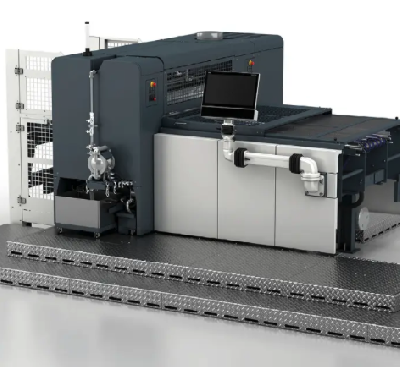
中文Prodigy Graphics, a trade-only offset printer serving customers throughout North America, is about to take delivery of two new Koenig & Bauer presses at its 75,000-square-foot facility north of Toronto: a Rapida 106 four-color plus coater and a Rapida 106 eight-color plus coater and perfector. President Najib Jamal says the investment reflects a simple formula that has powered the business for decades, quality, fast turnaround and customer service, backed by a commitment to running modern equipment.
Both new presses are equipped with Koenig & Bauer’s market-leading automation, incorporating inline quality and content control alongside comprehensive performance reporting on all job parameters. These advanced features are set to significantly enhance production efficiencies and unlock additional capacity. With the two new presses on their way, Jamal is confident he will realize a 40% increase in both efficiency and capacity, a step-change that would let the shop absorb more volume without a proportional rise in headcount or floor space.
For a trade printer, the economics of automation are decisive. Prodigy sells to resellers, brokers, graphic designers and commercial printers rather than end brands, which means it lives or dies on speed, consistency and price. Inline quality control catches problems before they become waste, and performance reporting gives customers the data they increasingly expect on turnaround and color. The eight-color plus coater and perfector configuration in particular compresses what used to be multiple passes into a single, efficient run, a competitive advantage in a market where lead time is often the deciding factor.
What the Announcement Covers
Jamal frames the purchase as the foundation for a host of new opportunities and expanding markets. A larger, more capable press fleet lets Prodigy chase bigger jobs, tighter deadlines and more demanding specifications, while the efficiency gains protect margins in a segment where buyers shop hard on price. The 40% capacity target is ambitious, but dual Rapida 106 installations are exactly the kind of capital bet that has historically separated growing trade shops from static ones.
The move also reflects broader confidence in North American print demand. Despite years of predictions that digital would erode offset, trade offset remains the workhorse for medium-to-long runs where unit cost and quality still favor lithography. Investments like this one suggest printers at the top of the trade tier see durable demand, especially as brands consolidate vendor lists and reward suppliers that can deliver both volume and reliability.
Koenig & Bauer’s automation pitch fits the moment. As skilled press operators become harder to find, presses that self-monitor, auto-adjust and document their own performance reduce dependence on heroics from any single operator. That resilience is valuable for a business built on promising customers a date and hitting it.
Prodigy’s expansion is a useful signal for the wider industry: the trade printing segment is not standing still. The shops winning today are those willing to invest in automation that turns capacity into throughput, and a 40% efficiency target, if realized, would reposition Prodigy as a larger, faster partner for the brokers and designers who depend on it. For Toronto’s print market, two more Rapida 106 presses on the floor is a concrete vote of confidence in the future of offset.
The trade-print market in which Prodigy operates rewards scale and speed above almost everything else. Brokers, designers and commercial printers choose trade partners on turnaround, price and reliability, and a 40% efficiency gain directly strengthens all three. The eight-color plus coater and perfector configuration is especially strategic because it collapses what used to be multiple passes into one, trimming both lead time and the defect surface that multiplies with handling.
Key Facts at a Glance
| Item | Detail |
|---|---|
| Subject | Prodigy Graphics |
| Key Figure | 40% |
| Year | 2026 |
| Source | https://www.printcan.com/news/2026/20260804864.shtml |
Why It Matters for Printers and Converters
- Who is moving: Prodigy Graphics is at the center of this development.
- The number that matters: 40% frames the scale of the commitment.
- Why converters should care: it signals continued momentum in the press segment of the printing and packaging value chain.
Automation also addresses the industry’s perennial talent problem. Skilled press operators are scarce, and presses that self-monitor, auto-adjust and document their own performance reduce reliance on any single hero operator. For a trade shop promising customers a date and needing to hit it, that resilience is as valuable as raw speed, and it protects margins when labor is tight.
The investment is a useful signal for the wider industry. Despite years of forecasts that digital would erode offset, trade lithography remains the workhorse for medium-to-long runs where unit cost and quality still favor analog. Shops willing to invest in automation that converts capacity into throughput are the ones winning broker and designer business, and Prodigy’s twin Rapida 106 order is a concrete vote of confidence in that future, both for Toronto’s market and for North American trade print more broadly.
Toronto’s position as a commercial-print hub makes the bet logical. Proximity to a dense designer and broker community, plus cross-border access to US demand, gives a well-equipped trade shop a large addressable market. The risk in trade print is rarely demand but throughput, and twin automated Rapida 106 lines are a direct answer to that constraint, letting Prodigy say yes to bigger, faster jobs without sacrificing the turnaround that won its customers.
Source: Based on “Prodigy Graphics Adding Two Koenig & Bauer Rapida 106 Presses” published by PrintCAN.
Looking ahead, this development is a signal worth tracking for the broader press sector. As capacity, materials, and investment shift, converters and brand owners who follow such moves early will be better placed to adapt.
Frequently Asked Questions
What is a printing press?
A printing press a printing press is a machine that applies ink to a substrate to reproduce text and images at volume. In the context of this story, it sits within the broader press segment of the printing and packaging value chain.
What is a printing press?
A printing press a printing press is a machine that applies ink to a substrate to reproduce text and images at volume. In the context of this story, it sits within the broader press segment of the printing and packaging value chain.
What is a printing press?
A printing press a printing press is a machine that applies ink to a substrate to reproduce text and images at volume. In the context of this story, it sits within the broader press segment of the printing and packaging value chain.
What happened with Prodigy Graphics?
Prodigy Graphics, a trade-only offset printer serving customers throughout North America, is about to take delivery of two new Koenig & Bauer presses at its 75,000-square-foot facility north of Toronto: a Rapida 106 four-color plus coater and a Rapida 106 eight-color plus coater and perfector. President Najib Jamal says the investment reflects a simple formula that has powered the business for decades, quality, fast turnaround and customer service, backed by a commitment to running modern equipment. According to the report, the move centers on prodigy graphics and its implications for the press industry.
Why does this matter for the printing and packaging industry?
Developments like this reflect the ongoing evolution of the press market. For label printers, converters, and brand owners, understanding where leading companies are investing helps anticipate shifts in technology, materials, and competitive positioning.
For related coverage, browse our printing & packaging news archive and the latest industry analysis on dhpack.net.
Source: https://www.printcan.com/news/2026/20260804864.shtml