 中文
中文Printer manufacturers hate the words “entry-level” and “budget.” They worry customers will assume they take these machines less seriously than the flagship kit at the trade show.
Which is a shame, because entry-level 1.6m roll-fed printers are quietly one of the most important product categories in wide format. Plenty of print shops started on one. Offset and flexo printers have used them to step into wide format without betting the company. And plenty of established providers buy them purely to add capacity without a terrifying finance agreement.
Nessan Cleary’s breakdown for FESPA is the no-nonsense comparison you want before signing anything. Here is the practical version.
First, about the price
Competition is fierce, so pricing is already keen with little room to squeeze the machine price further. But — the useful negotiating insight — dealers are often happy to move on other things. A RIP. A service contract. Even ink pricing.
That last one is where the real money hides. The sticker price is a one-time conversation. Ink is a conversation you have every month for the next five years. If you are going to push hard somewhere, push there.
Eco-solvent: the cheap, punchy starting point
For most people, this is the obvious first stop. Both the printers and the inks are the cheapest option, which makes the return-on-investment argument very hard to argue with.
How it works: the solvent in the ink binds pigments into the media’s surface coating, then evaporates away.
What it’s good at: very vibrant, punchy colours. Huge choice of coated media available. Popular for vehicle graphics specifically because the ink tolerates being heated and stretched — which anyone who has wrapped a curved bumper will appreciate.
The catch: it needs suitably coated media to work properly, and it is not suitable for long-term outdoor use. The ink may fade unless you laminate it.
That lamination requirement is the hidden cost nobody quotes you: extra process, extra material, extra labour, extra time. For vehicle wraps it does not matter, because you were laminating anyway. For outdoor signage, do the maths before you decide eco-solvent is the cheap option.
Some vendors offer optional heaters to dry ink faster, which lets you print faster. Worth asking about.
Example machine: the Roland DG TrueVis VG4-640 is a 1.6m eco-solvent printer.
Latex (resin): the sensible middle ground
Latex, also called resin ink, is a genuine step up. Roland DG and Epson both offer entry-level resin printers, and HP does too — along with larger 3.2m roll-fed and hybrid latex machines.
The environmental angle: the ink is water-based. No odour, no VOC risk. For some customers — particularly anyone printing for interiors, healthcare or schools — that is a real selling point, not just a marketing line.
The killer feature: strong colours with good scratch and UV resistance, making it suitable for outdoor work without requiring lamination. That is a distinct advantage over eco-solvent and makes latex a reasonable alternative to UV.
Read that again, because it contradicts the assumption that eco-solvent is automatically cheaper. Skip lamination and you skip material cost, a process step and turnaround time.
Also good: works across many media types including paper, vinyl and textiles. Ink dries quickly and prints can be dispatched immediately — no waiting for out-gassing or settling. That matters enormously if you are running same-day work.
The catch: the ink needs drying, which consumes energy and adds to running cost. And some resin printers run hotter than others, which can be a problem with heat-sensitive materials like window cling films. If cling film is part of your product mix, ask specifically about curing temperature. Newer machines like the HP R530 use lower curing temperatures to reduce energy consumption.
Worth flagging: HP sells the R530 as a 1.6m hybrid, complete with tables, giving you the option of printing to rigid boards. In a segment that is almost entirely roll-fed, that is unusual flexibility.
UV-curable: the widest range of substrates
UV ink is polymer-based. It cures through a chemical reaction triggered by UV light — these days almost always an LED array — which forces the polymers to crosslink, binding the ink film to the substrate.
The counterintuitive bit: the ink costs more than eco-solvent or latex, but UV printers consume less ink because nothing evaporates or dries off. They also do not use much electrical power.
So the ink price on the datasheet is misleading in both directions. Higher per litre, less consumed. Get real-world consumption figures for the work you actually do before you assume UV is expensive.
What it’s good at: adheres to a very wide range of substrates including banners, tarpaulins and vinyls. UV flatbeds will print to non-porous materials like metal and glass. The cured finish is reasonably tough, resistant to abrasion and ambient conditions, and suitable for outdoor display without lamination.
The honest caveat: the finish from a UV roll-fed printer is not as tough as from a flatbed — it cannot be, or the ink would crack as the media flexes. And on outdoor life, Cleary’s advice is worth heeding: some vendors claim unlaminated UV outlasts unlaminated latex, but formulations vary and media plays a role, so test your specific printer and media combination rather than trusting the brochure.
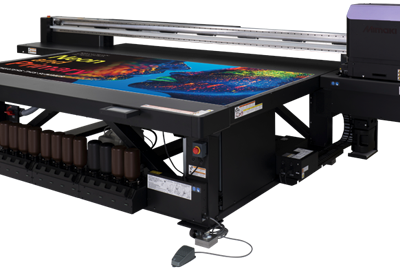
Example: Mimaki’s UJV200 Series is an entry-level 1.6m UV printer.
What you give up at this price point
Every budget machine involves compromises. Know them before you commit:
- Productivity. Many use a single printhead to keep costs down.
- Colours. Most are limited to CMYK. No light colours, no white, no orange or green extending the gamut.
- Features. Often no ability to print multiple layers for backlit or double-sided images.
- Maintenance. Entry-level models mostly rely on manual printhead and nozzle cleaning.
That maintenance point deserves emphasis. Manual cleaning is not a hardship, but it is a discipline — make sure operators are properly trained. A clogged head on a machine with no automatic maintenance cycle is how a cheap printer becomes an expensive paperweight.
The better news: technical improvements have filtered down. Today’s entry-level printers are faster and more robust than in the past, with better control software for error warnings and system status, plus features to help with roll loading and media feeding.
The bottom line
Cleary’s closing framing is the right one. The main role of an entry-level machine is as a relatively simple, low-cost device that just keeps churning out basic work with little intervention. These printers should pay for themselves within a couple of months. Looked after and kept clean, they can run for years — which can add up to a much better return on investment than more complex machines.
Better ROI than the expensive kit — the quiet argument for buying less machine than you think you need.
So: pick based on your actual work, not the spec sheet. Vehicle graphics and you are laminating anyway? Eco-solvent. Outdoor signage where lamination is dead time you cannot afford? Latex. Wide spread of odd substrates and possibly rigid work later? UV. And whatever you choose, negotiate on ink, not the machine.
Source: Written by Nessan Cleary for FESPA, 24 August 2026 — “What is the best entry-level wide format printer? Eco-Solvent, Latex, or UV?”