 中文
中文Walk a FESPA show floor and you will see mostly wide-format inkjet, a scattering of screen presses and the occasional label machine. Yet the clearest trend of the past decade is print service providers diversifying into complementary technologies rather than defining themselves by a single process. Understanding how single-pass inkjet, electrophotography, screen, offset and flexography actually work is now a business prerequisite, not a technical curiosity, because the shops that grow are the ones that match the right technology to the right application.
All graphics printing, at root, is about depositing coloured pigment onto a substrate. File preparation is broadly similar across processes, so a shop that masters one can expand into another with less pain than outsiders assume. That is the strategic logic behind diversification: adjacent technologies open adjacent markets, and the file workflow, colour management and finishing skills transfer more than operators expect.
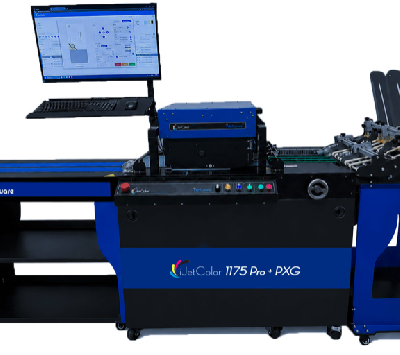
Single-pass inkjet arranges static printheads across the full media width, one colour per bar, with the substrate moving beneath directly to curing. There is no multi-pass error correction, so throughput on a limited substrate type is the whole point. It powers both water-based commercial document presses and UV LED label lines on synthetic and film stocks, and it is where the highest volumes in digital printing are actually achieved.
Electrophotography, mostly dry toner, charges a photoconductive drum, writes a latent image with a laser, and attracts negatively charged toner to the positive image areas before fusing with heat and pressure. The result is a wide-gamut, high-quality image on papers and films alike — which is why toner appears in label printers as well as document presses. HP Indigo’s liquid-toner variant keeps the same charged-particle principle while suspending toner in oil for different handling characteristics.
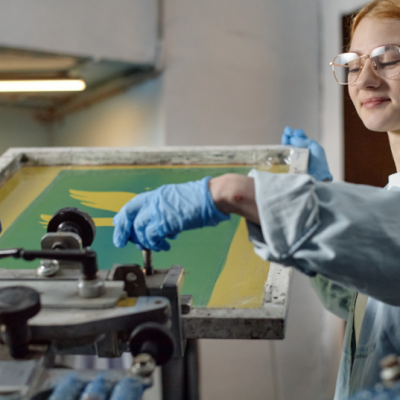
Screen printing pushes ink through a mesh stencil, building a full-colour image across multiple screens. Within the FESPA community it remains indispensable for industrial and textile work: unmatched vibrancy, wash-fastness on garments and scratch resistance on most substrates. No other analogue process matches its durability on difficult materials, which is why it survives alongside digital rather than being replaced by it.
Offset lithography dominates paper. A laser writes the image to an aluminium plate; oil-based ink adheres to image areas while water wets the non-image areas; the image transfers to a rubber blanket and then to the sheet. Sharp, fine text and runs from a few thousand to over a million copies make it the volume workhorse, mostly on B1 sheets though web-fed newsprint presses linger for the longest runs.
Flexography is arguably the most common packaging process, split between narrow web for labels and wide web for flexible film. Photopolymer plates carry the image; an anilox roller meters precise ink to the plate; the substrate picks up the image directly. Narrow web spans 250–680mm, typically 340mm, while wide-web CI presses 1–1.65m wide can be the size of a small house for the longest packaging runs at high speeds.
The lesson for a growing print business is that the differences between these technologies are mostly about substrates and market segments — packaging, garments, commercial documents — not about insurmountable complexity. A converter comfortable with one process should not be intimidated by another. The shops that thrive are the ones that route jobs to whichever press protects margin and meets the brief, treating technology as a toolbox rather than an identity.
Information source: FESPA (https://www.fespa.com/en/news-media/understanding-print-technologies-from-inkjet-screen-to-flexo-offset/).
This development arrives as the global printing and packaging industry navigates a period of simultaneous consolidation and specialization, where the ability to add a credible new capability — whether a sustainable substrate, a productivity tool or a diversified technology — increasingly separates the shops and suppliers that grow from those that merely hold market share. The companies and associations moving decisively now are positioning themselves to capture demand that will only intensify as regulations tighten and customers professionalize their own supply chains. For smaller players in particular, the lesson is that resilience comes less from scale alone than from the willingness to adopt proven technology and to communicate value clearly to a market that is rapidly professionalizing around them.
Looking ahead, the practical implication for print service providers and converters is that incremental improvement is no longer sufficient; the market rewards those who treat capability, sustainability and workflow as connected investments rather than separate line items. Whether the trigger is a new material, a new press or a new software layer, the winners tend to be the organizations that integrate the change into how they sell, produce and account for work. That integration is precisely what turns a headline announcement into durable competitive advantage, and it is why trade coverage of individual product launches is most useful when read as a signal of where the whole industry is heading next.