 中文
中文Flexography is undergoing a technological rebirth. Often dismissed as a legacy craft, it remains the undisputed market leader in global packaging print, and the technology is worlds apart from a decade ago. Deep digital upgrades across printing plates, ink control, and machine automation have radically overhauled the process, making modern flexo in 2026 highly cost-effective, hyper-competitive, and more productive for its core applications than ever before.
Flexo’s origins trace to the late 19th century as aniline printing, once a cheap, low-quality alternative to gravure and offset, known for halo effects and coarse screens. The shift to photopolymer plates changed everything. Because elastic plates conform to almost any substrate, from ultra-thin films to corrugated board, the process quietly captured the global packaging sector. Today flexo stands alongside offset, gravure, and digital inkjet as an industrial powerhouse, dominating the packaging value chain even as production inkjet advances with variable data.
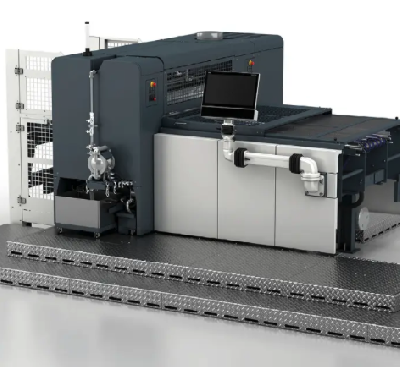
The mechanics explain the dominance. Flexo is a direct rotary relief method: image areas on the flexible plate are raised, non-printing areas recessed. An ink kitchen pumps liquid ink, water-based, solvent-based, or UV-cured, into an enclosed chambered doctor blade system that coats the anilox roller, a ceramic or metal cylinder engraved with thousands of microscopic cells. A doctor blade shears off excess, leaving a precisely metered film. The anilox transfers it to the raised plate elements, and the substrate passes between plate and impression cylinders with just enough resistance for a clean “kiss print.”
Color has expanded too. Each color needs its own plate and print unit, deposited sequentially at web speeds above 500 meters per minute, where registration accuracy is critical. Modern converters increasingly use Extended Colour Gamut, adding orange, green, and violet to CMYK. This fixed seven-color set simulates nearly 90% of traditional spot colors without press washouts, slashing changeover time and waste.
Flexo’s elasticity is its signature advantage, handling substrates where other methods fail, from stretchable films to coarse corrugated board. The payoffs are substrate versatility, high overall equipment effectiveness, crisp solids, and very low unit costs at scale. The limits are real: every color change needs a physical plate, making micro-runs uneconomic, and static plates cannot print variable data like individual QR codes. Historically, ink spread also blurred halftone edges.
Autonomous production has dismantled those weaknesses. Setting up a press used to depend on an operator’s gut feel; now intelligent automation fills the gap. High-resolution line-scan cameras monitor the moving web in a closed-loop system, analyzing the image in milliseconds and instructing servomotors to adjust cylinders in real time, holding the perfect kiss print automatically. Material science fixed ink spread: micro-structured plate surfaces hold liquid ink exactly where intended, pulling flexo quality level with offset or gravure.
The ecological footprint transformed as well. Plate making once relied on aggressive solvents; the industry is shifting to “Solvent ZERO,” with water-washable photopolymers processed using tap water recycled through filtration loops, drying faster and slashing prepress emissions. Flexo has not just survived; it modernized from within. It does not compete head-to-head with digital print but merges with it inside hybrid lines, where digital handles short variable runs and automated flexo remains the benchmark for profitable, high-volume packaging production in 2026.
Source: drupa blog (drupa.com)