 中文
中文Direct-to-object (DTO) printing has moved from niche curiosity to a strategic capability for brands and manufacturers that want to decorate products where they are made. At PRINTING United Expo, Engineered Printing Solutions (EPS) plans to make that case emphatically, bringing what it describes as one of the widest ranges of DTO technologies under a single roof and inviting visitors to compare them side by side.
EPS will occupy booth C2137, where attendees can evaluate decoration technologies that are rarely shown together: pad printing, single-pass inkjet, multi-pass inkjet and robotic printing solutions. The headline attraction is the XD-R robotic printing system, which pairs automated product handling with decoration, alongside the KP08 pad printer, the XD Series single-pass printer and the multi-pass DTO platform.
The point of gathering them in one place is practical rather than theatrical. Every application, as EPS executive chairman Kenneth Stack puts it, has different requirements for throughput, image quality, substrate compatibility and automation. A promotional product, a golf ball, a pharmaceutical cap and a rigid industrial part each favour a different process. By running live samples through multiple machines, EPS lets manufacturers see how each technology performs against their specific production goals rather than relying on a sales narrative.
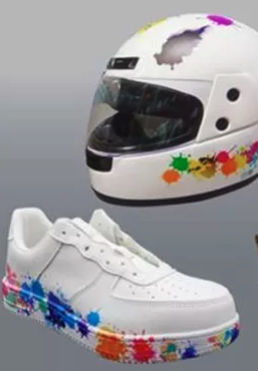
Throughout the show, EPS machines will run a wide variety of live samples. Visitors will see poker chips, golf balls and bottle openers printed alongside industrial safety signage, pharmaceutical caps and plastic food packaging. The demonstration is designed as a practical comparison of print quality, throughput, automation potential and substrate compatibility, with the substrate range deliberately spanning promotional, industrial, packaging and medical components.
“PRINTING United provides an excellent opportunity for manufacturers to compare technologies and see how pad printing, single-pass inkjet, multi-pass inkjet and robotic systems can each play a role in meeting production goals,” Stack said. The framing reflects a maturing market in which the question is less “which technology is best” than “which technology is right for this job.”
The robotic element speaks to a wider labour dynamic. EPS’s robotic printing system reflects growing demand from manufacturers for automated solutions that reduce dependence on manual labour, improve throughput, minimise operator intervention and deliver consistent, repeatable output. In an environment of tight labour markets and rising wage pressure, the appeal of taking the human hand out of repetitive decoration is obvious.
To support the conversation, the EPS team will share its recent white paper, The Shift in Direct-to-Object Printing. The paper argues that single-pass UV inkjet technology can improve return on investment through greater labour efficiency, lower setup costs and faster payback in suitable applications. That message resonates with manufacturers weighing capital expenditure against the cost of manual decoration lines that are difficult to staff and hard to scale.
DTO printing’s value proposition spans remarkably diverse sectors. EPS systems are built for everything from promotional products and sporting goods to industrial parts, packaging and medical components. At PRINTING United, the company’s presence will offer manufacturers one of the broadest opportunities at the show to evaluate DTO printing technologies, automated workflows and robotic production solutions in a single visit.
“Whether visitors are producing promotional products, industrial components, packaging or medical devices, we want them to leave with a clearer understanding of which technology is right for their application,” Stack added. By bringing multiple print technologies together, EPS aims to make it easier to compare traditional and digital processes and to see where DTO printing can deliver the greatest impact.
For print service providers, the implications extend beyond decorative novelty. DTO opens revenue streams that do not depend on flat-sheet or roll-fed work, letting shops take on dimensional products that competitors cannot handle. For brand owners, it enables late-stage customisation, shorter runs and personalisation without the tooling and lead times of traditional methods. The commercial upside is clearest where a product’s value is enhanced by printing directly onto its surface rather than onto a label applied afterwards.
The commercial logic for attending is equally clear. Decorators evaluating a capital purchase rarely get the chance to run their own parts through competing technologies in one afternoon, and the gap between a vendor’s specification sheet and real-world throughput is where budgets are won or lost. EPS’s booth is engineered to close that gap, translating abstract capability into measurable output across substrates that mirror actual production.
PRINTING United has become the natural stage for this kind of cross-technology comparison, drawing decision-makers from in-plant, commercial, industrial and packaging print. EPS’s decision to foreground the contrast between processes rather than push a single machine is a shrewd recognition that buyers arrive with very different problems to solve. As decoration converges with automation, the winners will be those who can match process to part, and EPS’s booth is, in effect, a working seminar on that principle, one live sample at a time.
Source: WhatTheyThink, published 4 September 2026.