 中文
中文L’Etiquette Adhésive, a privately owned label converter based in Pau in south-west France, is reporting significant productivity gains from a Mark Andy Digital Series HD (DSHD) press installed in 2024. It is the company’s first Mark Andy press at the plant, and the hybrid machine was acquired to handle growing demand for more SKUs in shorter run lengths more economically, a challenge that was proving expensive on its existing equipment.
Stéphane Clavier began looking to acquire a B2B company in 2019 and found L’Etiquette Adhésive suited his aim of growing a business outside the retail sector. The Covid-19 pandemic followed, but far from damaging demand, Clavier said it actually increased demand for labels to a level that has largely been sustained ever since. A move to a new and larger building in 2019 also provided space for a planned investment program that continues today.
Clavier inherited a machine line-up that included flexo and digital toner presses as well as offline converting equipment. However, the growth in demand for more SKUs in shorter run lengths was hard to handle economically, and he began scanning the market for a solution. Coming from a non-print background, he was initially unaware of what hybrid technology could offer, but he asked well-known press manufacturers to show him a hybrid press running at a converter producing similar work. Only Mark Andy was able to do this, and the demonstration was so convincing that within a month the order was placed.
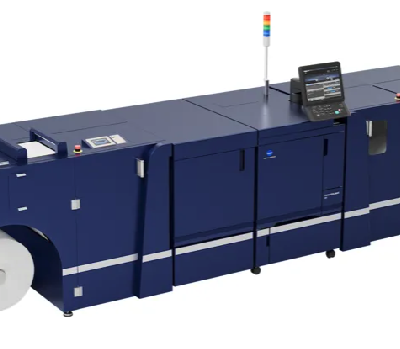
The DSHD has a 430 mm web width and is based on the Performance Series flexo platform. A five-color (CMYK plus white) UV-inkjet digital engine sits between the flexo print stations, two before and three after the digital engine. These stations allow additional colors to be printed, a lacquer to be added, or cold-foil to be applied. The press also has turn bars, a double unwind for two-web insetting, two Gizmos for multi-layer coupon labels, and a semi-rotary die-cut station, with an overhead extraction unit handling complex waste matrix. Together, these features allow single-pass operation from blank roll to finished label.
As labels become more complex and brand owners specify more expensive substrates, waste material becomes a major issue and cost center. Make-ready time and material waste on the flexo presses make all but longer jobs uneconomical, while the running speeds of the toner presses and offline finishing equipment also pointed toward the hybrid having an efficiency advantage. Clavier admitted there was a learning curve in synchronizing digital and flexo print with the converting elements, but the Mark Andy, which was working double-day shifts, is now on three-shift operation and very productive.
The DSHD allowed Clavier to move work from both his flexo and digital lines, freeing capacity for the jobs those lines suit best. Around 90 percent of work at the Pau plant is printed and converted using filmic materials, and one major customer recently changed its requirement to all PP, with the opacity of the digital white on the Mark Andy quickly filling capacity. Most work is supplied to customers within the local region, and turnover is set to grow from Euro 7.8 million this year to Euro 8.4 million in 2027.
Speaking for Mark Andy, Stéphane Rateau, newly appointed sales agent for France, said L’Etiquette Adhésive is an excellent case study of developing a label converting business through strategic investment and embracing the latest technology, with a delivery performance rating above 98 percent. He promised Mark Andy is fully committed to ensuring the Digital Series HD press maintains that level of excellence.
The French label market, like its European neighbours, has tilted sharply toward shorter runs and versioned SKUs as brand owners test variants and chase faster time to shelf. That shift punishes traditional flexo, where plate costs and make-ready dominate economics below a certain volume, and it rewards hybrid architectures that blend the best of both. L’Etiquette Adhésive’s experience, moving work off both its flexo and toner lines onto the DSHD, is a textbook case of right-shoring jobs to the most efficient engine.
Clavier’s candour about the learning curve is notable. Synchronising digital and flexo print with inline converting required a new mental model for the team, yet the press moved from double-day to three-shift operation, a clear signal that the efficiency gain was real rather than theoretical. With turnover projected to rise from Euro 7.8 million to Euro 8.4 million in 2027 and a delivery performance rating above 98 percent, the investment reads as a strategic platform for the next phase of growth rather than a one-off capacity add.
For Mark Andy, the installation is a useful reference in a market where hybrid presses must prove they can handle real commercial workloads, not just demos. Clavier’s willingness to shift volume from existing flexo and toner lines onto the DSHD is the strongest possible endorsement, and the 98 percent delivery rating gives prospective buyers a concrete benchmark. As French and European label converters face the same short-run, high-SKU pressure, L’Etiquette Adhesive’s experience offers a practical template for right-sizing capacity without multiplying machines.
Source: THE PACKMAN (https://thepackman.in/letiquette-adhesive-installs-mark-andy-hybrid-press/)