中文
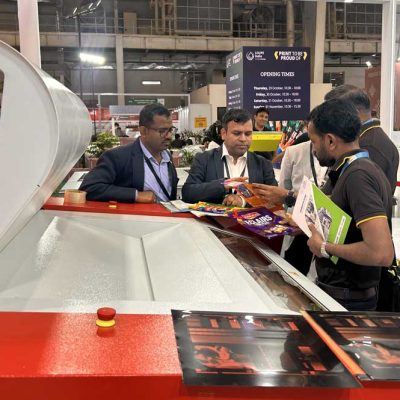
Heidelberg has sold a Gallus Five hybrid digital press to Ahmedabad-based Letra Graphix, with the deal announced at LOUPE India 2026. The installation will make Letra Graphix the first company in Asia to run the machine — a distinction that matters less for the bragging rights than for what it says about where premium label production is heading.
For Letra Graphix, the purchase is the company’s second hybrid press acquisition, taken deliberately as it expands its capabilities in premium label production. Sahil Shah, director at Letra Graphix, put the rationale plainly: the press will help the company produce high-end, high-quality labels. That is the language of a converter who has already established what hybrid technology does for a business and is now scaling it rather than testing it.
The Gallus Five was unveiled at Labelexpo Europe 2025 and combines digital inkjet printing with conventional printing and finishing processes in a single hybrid configuration. It sits within the Heidelberg and Gallus digital printing portfolio, and is aimed squarely at label converters who need flexibility across a mixed production requirement: short runs, variable content, and labels carrying value-added finishes.
That combination — short runs plus premium finishing — is precisely where the label industry’s economics have been re-forming. A decade ago, hybrid presses were a compromise: digital where you needed variable data, flexo where you needed speed, and a certain amount of apologising for the seams between them. The current generation is being bought for a different reason. Brand owners want more SKUs, more frequent design refreshes, more regional variants and more embellishment, all within lead times that make a pure flexo set-up uneconomic and a pure digital set-up uncompetitive on long runs. A hybrid line lets a converter accept the job mix rather than choose between halves of it.
Samir Patkar, president at Heidelberg, framed the sale in those structural terms: the installation underlines the growing role of hybrid technology in label production, as converters seek to broaden their application capabilities and serve premium label requirements.
The choice of Letra Graphix as the first Asian installation is itself informative. India’s label market has expanded rapidly on the back of domestic consumption, pharmaceutical packaging, food and beverage, and a growing craft beverage segment that values tactile and decorative effects. Ahmedabad has become a genuine label-production cluster, with converters investing in wider webs, faster changeovers and more decoration stations. A converter in that environment does not need a hybrid press to survive; it needs one to compete for the premium tier of work where margins are set by effect and turnaround rather than by price per thousand.
The wider read-across for the region is that Asia is no longer a lag market for high-end press technology. Historically, the first installations of a new European platform went to Germany, Italy or the UK, and Asian converters received the machine two or three product cycles later. That pattern has broken down in labels, where Asian converters are now frequently the ones pushing application boundaries because their brand-owner customers are demanding faster and more varied decoration.
What to watch next is the utilisation question. A hybrid press only returns its capital when the job mix actually uses both halves of its capability — digital for the variable and short-run work, conventional stations for the volume and the effects. Converters that buy hybrid capacity and then run it as a very expensive digital press tend to discover that the business case was built on assumptions about order mix that never materialised. Letra Graphix’s second hybrid purchase is at least evidence that the first one worked.
For Heidelberg and Gallus, the sale continues a strategic repositioning. The group has been rebuilding its label presence around digital and hybrid platforms rather than defending conventional flexo alone, and regional firsts are useful proof points in a market where converters benchmark against their neighbours. The machine that arrived in Ahmedabad will be looked at closely by converters across India and Southeast Asia before their own capital committees meet.
The configuration decisions behind a hybrid press purchase are more consequential than the headline specification. A converter has to decide how many flexo stations to carry, whether to include cold foil or a screen unit, where the inkjet engine sits in the sequence, and whether the finishing end is inline or near-line. Each choice loads the capital cost and narrows the range of jobs the line can accept. The converters who get hybrid presses right tend to be the ones who designed the configuration around a named list of target customers and their actual label constructions, rather than around the widest possible capability.
Staffing is the other variable that rarely appears in the business case. A hybrid line asks an operator to be competent in two different technologies, and the skills do not transfer automatically. Press minders trained on conventional flexo often underestimate how much attention inkjet heads and their maintenance routines demand, while digital operators can struggle with the mechanical discipline that web handling and die-cutting require. Training plans that treat the press as a single machine, rather than two technologies sharing a frame, are the usual cause of a slow and expensive first year.
Source: The Packman — https://thepackman.in/letra-graphix-to-install-asias-first-gallus-five-hybrid-press