 中文
中文On 9 and 10 April 2026, the Croatian print community rallied behind the University of Zagreb Faculty of Graphic Arts at MUZZA Zagreb, one of the country’s leading science and technology festivals for children. The event drew hundreds of young visitors into the world of STEM subjects, and graphic sciences played an outsized role in sparking curiosity about future careers. With support from FESPA, the university was able to build a more engaging, hands-on introduction to print than in previous years.
MUZZA is designed to ignite curiosity among primary school-aged children through interactive exhibits and practical demonstrations. Building on the university’s successful participation in earlier editions, the 2026 project aimed to deepen its presence and make the world of print even more accessible to a young audience. The goal was not to recruit printers on the spot but to plant a seed: that the creative, technological and innovative side of print is worth exploring later in life.
FESPA’s contribution was practical and visible. Organisers supplied the university with a modular lightbox exhibition stand, a promotional counter and several sets of soft signage. These materials enhanced the university’s display during the festival and, importantly, will be reused at future outreach events, providing a lasting resource for promoting graphic sciences across Croatia. Rather than a one-off splash, the investment creates an asset that keeps working for years.
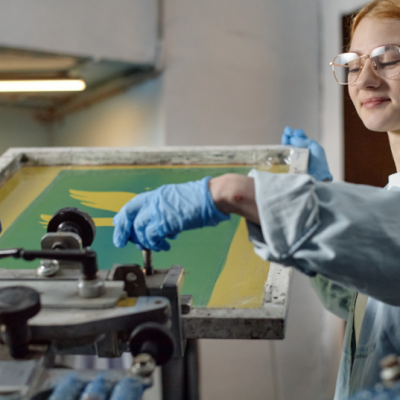
Throughout the festival, university staff welcomed children and their families to the stand and introduced them to the wide range of technologies and creative opportunities within the industry. The initiative showcased the diversity of modern print, highlighting sectors including industrial and functional printing, screen printing, signage and graphics, textile printing and wide-format digital printing. For a child who thinks printing means a home inkjet, the breadth on display is genuinely eye-opening.
The festival maintains a strict non-commercial policy that prohibits corporate branding and sponsorship, which created a subtle challenge for acknowledging support. Organisers navigated this gracefully, placing “Supported by FESPA” stickers on the exhibition systems and promoting the project through social media, ensuring the backing was recognised while fully respecting the event’s guidelines. It is a model other associations could replicate where event rules forbid overt branding.
The festival also served as a platform for future development. Organisers plan to build on this year’s success by introducing interactive print experiences at future editions of MUZZA, letting children engage directly with the technology through activities such as live screen printing demonstrations and the use of special effect inks. Those hands-on moments are intended to make print even more memorable and accessible, turning passive observation into active participation.
Securing commercial sponsorship proved difficult precisely because of the festival’s branding restrictions. As a result, FESPA’s funding was instrumental in making the enhanced exhibition possible. The investment supported the 2026 event and created exhibition materials that will continue to promote the graphic arts industry long afterward, delivering long-term value for educational outreach that far exceeds the initial outlay.
By introducing young people to the creativity, technology and innovation behind modern print, the project strengthened industry awareness at an early age. As the print sector continues to invest in developing future talent, initiatives such as MUZZA demonstrate the importance of engaging children through inspiring, hands-on experiences that may one day shape their educational and career choices. In a labour market where skilled print professionals are increasingly scarce, planting that seed early is not a nice-to-have but a strategic necessity.
The skills gap is one of the print industry’s quieter existential risks. As experienced operators retire and young people gravitate toward perceived high-tech careers, the sector struggles to refill the pipeline with talent that understands both the craft and the technology. Initiatives like MUZZA are a front-line response: reach children before career paths harden, and show that print is genuinely creative and technological rather than dated. Associations have a distinctive role here, because few individual companies can justify the outreach investment alone, whereas a collective body can fund exhibition kit and coordinate with universities. The Croatian model, blending a festival, a faculty and an association, is replicable across other markets where print needs a stronger talent narrative. The long-term payoff is not immediate recruitment but a generational shift in how the industry is perceived by exactly the people it will need in a decade. Crucially, the non-commercial framing matters. By respecting the festival’s no-branding rule and earning recognition through discreet stickers and social promotion, FESPA and the university modelled the patience that educational outreach requires. Quick-win marketing this is not; the value accrues over years, as the children who pressed their first screen print in 2026 become the students and apprentices of 2030. Associations that invest patiently in this kind of outreach are effectively seeding their own future workforce, and the returns, though slow to arrive, are among the most durable any industry body can earn.