 中文
中文There is an unintended documentary buried inside Danny Boyle’s new film. Ink, which premiered at the Venice Film Festival, dramatises Rupert Murdoch’s early years in British newspapers — London in 1969, the acquisition of The Sun, and the paper’s transformation from a struggling title into a tabloid phenomenon. To shoot it, the production needed a working large-scale press hall. It found one in Watford. Shortly after filming wrapped, that press hall closed.
Boyle told the story himself during a press conference on Wednesday 2 September, prompted by a journalist from Athens who asked whether the printing press industry would still be with us years from now, whether it would find ways to survive, or whether it would vanish altogether.
“There’s a really sad addendum to that,” Boyle answered, “which is that we were very fortunate to film in a printing press for the film in Watford, and it was one of the few remaining largescale printing presses in Britain.” The production returned later for pickup shots. Then, while editing was still underway, the site called them. “They rang us up and said, ‘we’re closing, there’s not enough work’.”
His summary of the consequence was blunt: “So now there’s only one place around London where the papers are printed.”
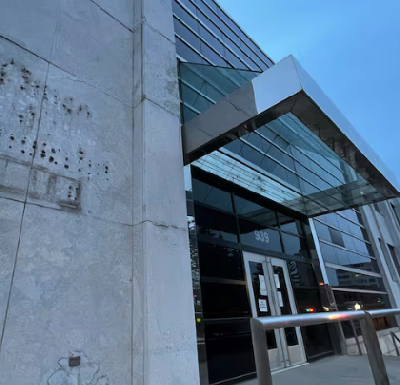
The site was the Odhams building in Watford, which ran its final day of printing on Sunday 19 July and had previously housed Reach’s print operations. Odhams was not an anonymous industrial shed. It was one of the recognisable landmarks of twentieth-century British publishing, a building whose scale reflected an era when newspaper production was a heavy-industrial activity conducted at volume near the market it served. Its closure ended a long and continuous era of print at that address.
Boyle went on to note that his subject is himself a product of that world, calling Murdoch a “print man” and observing, “I’m sure it drives him to despair the disappearance of the print industry, the tactile world that we used to depend on to read our stories.” It is a striking line, and a reminder that the commercial logic that eventually hollowed out newspaper printing was set in motion partly by the same proprietors who built its greatest capacity.
The film itself was shot in late 2025 into early 2026 across London and Yorkshire. It stars Jack O’Connell, Guy Pearce and Claire Foy, and is adapted from the stage play by James Graham. Alongside Murdoch’s arrival in Fleet Street, the drama follows his relationship with editor Larry Lamb, the man he appointed to reinvent the paper — a partnership that produced both the commercial formula and the editorial controversies that defined the modern British tabloid. The portrayal has already generated argument: the BBC’s Nicholas Barber noted that the film’s flattering treatment of Murdoch himself is causing debate, while Boyle maintained at the press conference that the film “doesn’t monsterise” him. Ink reaches UK cinemas on 8 January before arriving on Netflix.
For the print industry, though, the interesting story is not the casting or the critical reception. It is what the production’s location scouting inadvertently documented. A film needing an authentic large-scale British newspaper press hall in the mid-2020s has a shortlist, not a market. And the site it chose became unviable during post-production — not because of a strategic pivot or a technology transition, but for the plainest reason in industry: there was not enough work.
That is worth sitting with, because it describes a specific and under-discussed failure mode. Newspaper print capacity does not decline smoothly in proportion to falling circulation. It declines in steps, because a web offset newspaper plant is a high-fixed-cost asset that needs volume to justify its existence. As titles cut pagination, reduce print frequency, or move to digital-first, the volume drawn down from any individual plant falls below the threshold at which running it makes sense — and then the entire plant goes, all at once, taking its skilled workforce with it. What remains is consolidated into fewer sites serving larger geographies.
The consequences ripple outward in ways that are invisible until they bite. Longer distribution runs mean earlier editorial deadlines, which means less late news in the paper, which makes the printed product marginally less valuable, which accelerates the decline that caused the consolidation. Regional resilience erodes: with one site printing for a whole area, a mechanical failure or industrial dispute has no local fallback. And the specialist labour pool — press crews, maintenance engineers, people who understand how to run a newspaper web at speed — disperses into other industries and does not reassemble.
None of this is an argument that the trend is reversible. Newspaper print volumes reflect reader behaviour, and no amount of manufacturing efficiency changes that. But there is a difference between a managed contraction and an unmanaged one, and the print sector has largely experienced the latter. Buildings close, tooling is scrapped, expertise walks out, and the capacity is not coming back if demand stabilises or if a niche — premium print editions, specialist titles, high-quality inserts — turns out to have durable value.
Boyle’s film will introduce a large audience to the physical romance of a press hall in full cry, the noise and scale and choreography of it. It will do so using footage of a building that no longer prints. That is an accidental epitaph, and a fairly precise one.
Source: Based on reporting from Printweek.