
 中文
中文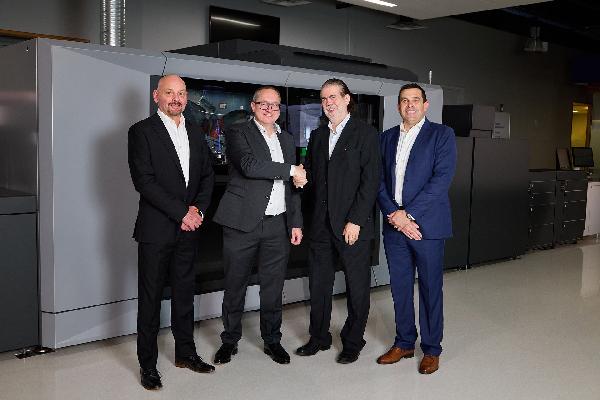
Some purchases happen on a whim. This one did not. When CJ Graphics in Mississauga, Ontario, decided to install North America’s first Heidelberg Jetfire 50, the decision capped nearly two years of homework – a methodical sweep of every major inkjet press on the market, even though the two companies have been close for more than four decades.
That detail tells you everything about how serious this is. CJ Graphics did not buy from a friend out of habit. It looked at the field, ran the numbers, and still landed on HEIDELBERG. The Jetfire 50, being installed this month, joins a six-colour Speedmaster XL 106 and two new Versafire digital engines as the company leans harder into what it calls hybrid production – the art of mixing offset, digital and finishing under one roof so the right job lands on the right machine.
The specs are the part that should make competitors wince. The Jetfire 50 runs at up to 4,560 SRA3 sheets per hour in duplex mode, with 90% availability. Those two numbers – speed and uptime – are the ones that decide whether an inkjet press is a showpiece or a workhorse. For short runs that need both quality and flexibility, that combination is exactly what a high-volume shop is hunting for.
CJ Graphics is no stranger to scale. It operates out of a 214,000-square-foot plant in Mississauga with offset, digital, die cutting and wide-format capability, and it claims to be the most awarded printer in the world, with more than 6,500 awards to its name. It was also listed as Canada’s 41st largest printer by Graphic Monthly. When a shop that size, with that trophy cabinet, bets on a brand-new platform, it is not dabbling. It is placing a marker on where commercial print is heading.
Jay Mandarino, the company’s president, has been clear that the relationship with HEIDELBERG goes back more than 40 years. But the telling line from the announcement is that his team “looked at every major inkjet press available in the marketplace” before committing. In other words, loyalty did not buy the order – capability did. That is a healthy dynamic for the whole industry: vendors have to keep earning the business, even from their oldest friends.
The bigger picture is the slow death of the either-or question. For decades, a commercial printer picked a lane – offset for volume and quality, digital for short runs and speed – and lived with the trade-offs. Hybrid production dissolves that choice. A shop like CJ Graphics can take a long-run job on the Speedmaster and a personalised short run on the Jetfire without missing a beat, then finish both under the same roof. The customer never has to know, or care, which machine did the work. They just get the right result at the right price.
There is a competitive warning buried in this, too. When one of Canada’s largest and most decorated printers installs the first Jetfire 50 in North America, it raises the bar for everyone else in the region. Mid-size shops that cannot match CJ’s firepower will need to find niches the giant does not bother chasing – hyper-local service, specialised substrates, speed-to-market on small runs. The alternative is to be out-spec’d on the jobs that pay the bills.
The discipline behind the deal is the real story. Not the trophy of being first, but the quiet rigour of a company that spent two years deciding and then committed without flinching. In an industry prone to both impulse buys and analysis paralysis, CJ Graphics managed the hard middle path: research relentlessly, then act. For HEIDELBERG, the win is more than a press sale – it is validation that its inkjet platform can earn its place alongside a six-colour Speedmaster in the most awarded printer in the world.
And for the broader market, the message is that the hybrid future is already being installed in Mississauga, not sketched on a roadmap. The shops that treat inkjet as a complement to offset, rather than a threat to it, are the ones that will thrive. CJ Graphics just showed the rest of North America what that looks like in practice.
There is a quiet confidence in a company that researches for two years and then commits without flinching. Too many printers either buy on impulse or stall in permanent analysis. CJ Graphics occupied the disciplined middle – and that is precisely why its endorsement carries weight. When the most awarded printer in the world says a platform is ready for prime time after a full evaluation, rivals and customers alike take notice. HEIDELBERG could not have asked for a better reference account.
The broader implication for the North American market is that the hybrid model has just gained a flagship proof point. For years, sceptical printers treated inkjet as a short-run novelty that could never challenge offset on quality or cost at volume. A shop with 6,500 awards and a 214,000-square-foot plant betting its hybrid future on the Jetfire 50 undercuts that scepticism decisively. When the most decorated printer on the continent commits, the argument shifts from “if” inkjet belongs in high-volume commercial work to “how fast” rivals must adapt.
Source: PrintCAN


