 中文
中文Imagine taking a photograph of the thing you love most, and never being able to look at it. That was the situation for seven students at RSBC Dorton College in Orpington — until the picture came back with a surface they could read with their fingers.
Canon has teamed up with the Royal Society for Blind Children on a photography exhibition built entirely around tactile print. The images can be experienced by touch, alongside spoken description and storytelling. It sounds like a small idea. In practice it rearranges who photography is for.
The project began late last year, through Canon’s Young People Programme, which supports young people from deprived backgrounds and communities. Cinematographer and photojournalist Elisa Iannacone, a Canon Ambassador, ran a workshop with the seven students at Dorton College.
The brief was refreshingly unsentimental: make a portrait about what you actually love doing. Not photograph your disability. Photograph your thing. The students used the camera as a creative tool for saying who they are — identity and personality, framed by the person living it rather than described by somebody else.
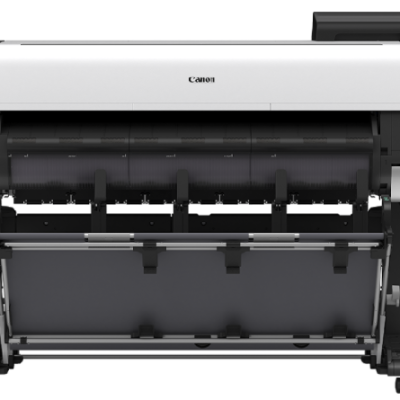
Then came the part that makes this a print story. Those portraits were converted into tactile relief prints using Canon’s elevated printing technology, produced on a Canon Arizona 2380 XT driven by PRISMAelevate XL software.
The technique is genuinely clever. The software builds carefully developed height maps, and the press lays down multiple layers of UV-curable ink to construct raised textures. In Canon’s words, the process gives each image “a physical dimension that can be explored by hand”. A face stops being tone and becomes topography.
Height maps are the unglamorous hero of the process. Get them wrong and a portrait turns into an unreadable smear of ridges. Get them right and an eyebrow, a cheekbone and the edge of a jaw arrive under the fingertips in the right order. That is craft work, not a button press, and it is where shops offering this will win or lose.
For anyone in wide-format, this is worth pausing on, because it reframes the machine in the corner of the shop. An Arizona flatbed is usually sold on rigid signage, point-of-sale and short-run display work. Here the same platform is producing something no signage brief would ever generate: an image a blind teenager can read.
The response, by all accounts, landed hard. “It’s been wonderful to see how this project has helped students experience photography in a completely new way,” said Neale Conroy, marketing director, Imaging Technologies & Communications Group, Canon UK & Ireland.
“At Canon, we believe imaging should inspire curiosity, confidence and creativity, and this collaboration with RSBC brings that to life in such a meaningful way,” Conroy added. “By using elevated print technology to make images accessible through touch, we’re helping more young people connect with visual storytelling and share their own perspectives.”
From the college side, Sarah Mallion, vice principal and head of business and operations at RSBC, described what it looked like in the room. “Seeing students engage with their own work in such a tactile and meaningful way has been incredibly rewarding,” she said.
Then the detail that tells you it worked: “The response from students’ families has been overwhelmingly positive, and the project has shown how technology can open up new ways for young people to connect with creativity.” Families, note — not just students. Parents who have spent years describing photographs out loud, now watching their child explore one unaided.
Mallion said RSBC hopes this is a beginning rather than a one-off, with more accessible exhibitions and learning experiences to follow. That ambition is where the commercial opportunity quietly sits.
Because if you run a wide-format shop, ask yourself who else needs this. Museums with collections most visitors can see and some cannot. Galleries under pressure to prove accessibility rather than promise it. Schools. Public buildings. Heritage sites with wayfinding that assumes sight. None of these buyers are shopping for elevated print by name, but all of them have an accessibility problem with a budget attached to it.
Canon has been building this story for a while. At its Drupa 2024 booth the company showed The Core, a multisensory immersive space that included The World Unseen experience, built around elevated prints. What was a showpiece two years ago is now doing a job in a college in Orpington. That is usually the sign a technology has stopped being a demo.
A little context on the partner matters here. The RSBC was founded in 1838 and supports blind and partially sighted children and young people, along with their families. Last year it provided activities and events for 1,515 service users and delivered 33,750 hours of inclusive education. This is an organisation with reach, not a pilot scheme.
It is easy, in an industry obsessed with speed, square metres and cost per print, to forget that print has one advantage no screen will ever take away: it exists physically. You can hold it. And if you can hold it, you can read it with your hands.
Seven students walked into a workshop with cameras and walked out with portraits they can feel. Whatever your press is running this week, that is a decent reminder of what the technology is actually for.
Source: Printweek — “Canon’s tactile prints make powerful connection with RSBC students” by Jo Francis, 20 August 2026. Original article: https://www.printweek.com/content/news/canons-tactile-prints-make-powerful-connection-with-rsbc-students