 中文
中文Every corrugated converter knows the gap between the number on the spec sheet and the number on the production report. A die-cutter rated at 7,000 sheets per hour rarely delivers 7,000 sheets per hour across a shift, because the machine does not fail dramatically — it hesitates. A gripper misaligns. Waste jams in the chute. The chain slackens. A guard has to be opened. Each interruption lasts seconds to minutes, none is logged as downtime, and collectively they remove a substantial fraction of theoretical capacity.
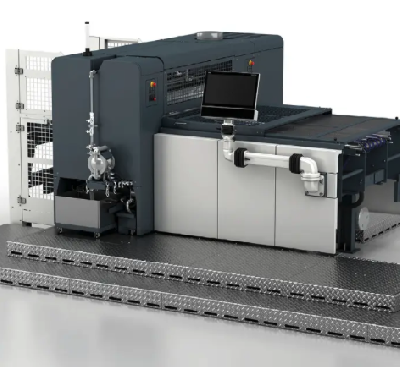
Koenig & Bauer has introduced the CutPro 2.1, a new flatbed die-cutting machine for corrugated board processing, and has been unusually direct about which number it is optimizing. The company states that a key focus was improving net output rather than simply achieving theoretical maximum production speeds.
The Specification
The CutPro 2.1 processes sheet sizes up to 1,300 x 2,100mm and operates at speeds of up to 7,000 sheets per hour. It handles a range of materials from solid board through to corrugated board.
Those figures place it firmly in mainstream corrugated and folding carton territory. A 1,300 x 2,100mm maximum sheet covers the large majority of shelf-ready packaging, shipper cases and display work, and 7,000 sheets per hour is competitive rather than record-setting. The material range from solid board to corrugated matters for converters running mixed work, since a machine restricted to one substrate class forces either job routing constraints or a second machine.
But the headline specifications are not the argument the manufacturer is making. The claim is about what proportion of that 7,000 figure a converter actually realizes.
Designing Against Micro-Stops
The machine has been engineered specifically to reduce unexpected stoppages and micro-stops that affect overall productivity during continuous manufacturing. Two named technologies address the mechanical root causes.
Varioplan and Variolever help synchronise gripper movements and reduce the typical causes of machine stops. Gripper synchronisation is the fundamental reliability problem in flatbed die-cutting. Sheets are carried through the station on a gripper bar system, and the bars must arrive at exactly the right position at exactly the right moment. Any drift produces misregistration, and misregistration produces either scrap or a stop. On a corrugated sheet — which is compressible, variable in thickness and prone to warp — maintaining that precision is considerably harder than on flat paperboard. Addressing gripper synchronisation directly targets the most common failure mode rather than a peripheral one.
Three further features attack setup and maintenance time. An automatic chain tensioner removes a recurring manual adjustment; chain tension drifts with wear and temperature, and slack chain degrades timing precision, which loops back into the gripper problem. Improved waste routing within the die-cutter addresses one of the most mundane and most frequent causes of unplanned stops — trim and nicked waste that fails to clear and eventually blocks the path. And a safety mechanism for manually moving the die-cutting unit makes makeready both faster and safer, in a task operators perform constantly.
All of these features are expected to reduce maintenance and set-up time. The machine is also designed to prioritize consistent production performance and minimize downtime in operations.
Why the Framing Matters
The decision to market a machine on net output rather than rated speed is a departure from convention in packaging machinery, where peak-speed figures have long dominated specification sheets and sales conversations.
The reasoning is sound. Consider a converter running a die-cutter across two shifts. If a machine rated at 7,000 sheets per hour realistically sustains 4,500 because of accumulated micro-stops, changeovers and adjustments, then a competing machine rated at the same 7,000 that sustains 5,500 delivers roughly 22% more production. No specification sheet captures that difference. It appears only in overall equipment effectiveness data, which is exactly where a converter’s cost per thousand is actually determined.
There is also a labour dimension. Every micro-stop requires an operator to intervene. A machine that stops frequently demands close attention, which limits how many machines one operator can supervise. Reducing interruptions is therefore not only a throughput gain but a staffing consideration — increasingly relevant in a sector where experienced die-cutting operators are difficult to recruit.
Reading the Competitive Position
Koenig & Bauer occupies a particular position in this market as the world’s second-largest offset press manufacturer, with corrugated and folding carton converting equipment forming a growing part of its portfolio. The company has been steadily expanding its packaging presence, and the CutPro line sits alongside its printing systems as part of an integrated offering.
That integration is part of the appeal for converters. A supplier providing both the press and the die-cutter can address register and timing relationships across the full production chain, and offers a single service relationship rather than two.
The reliability-focused positioning also implicitly acknowledges where the corrugated market sits. Demand is driven substantially by e-commerce packaging and shelf-ready retail formats, both of which favour shorter runs and more frequent changeovers than traditional case production. In a short-run environment, setup time and stop frequency matter proportionally more than top speed, because a machine spends a greater share of its day changing over rather than running. A die-cutter engineered around faster makeready and fewer interruptions is aimed precisely at that pattern of work.
The Practical Question for Buyers
For converters evaluating the CutPro 2.1, the useful due diligence is not a specification comparison but a measured one. The relevant question is what net output the machine sustains on the buyer’s own job mix, over a full shift, including changeovers — and how that compares with current equipment.
Koenig & Bauer has effectively invited that comparison by declining to compete on rated speed. If the engineering delivers as described, the difference will show up in OEE figures rather than on the nameplate. That is a harder claim to demonstrate in a sales meeting, but a more meaningful one on the production floor.
Source: PrintCAN, August 18, 2026 — Koenig & Bauer Introduces CutPro 2.1 Die-Cutter