 中文
中文FESPA’s Print Make Wear feature is returning with an expanded format, offering visitors a live, end-to-end tour of garment decoration and production rather than a series of disconnected equipment demos. The feature has become one of the most popular draws at FESPA events, precisely because it shows technologies working together on real products instead of sitting in isolation on a stand. For printers evaluating a move into textiles, that integrated view is far more instructive than a row of separate machines.
The concept is deceptively simple. Rather than exhibiting a single press or a lone curing unit, Print Make Wear assembles a working production line on the show floor, taking a garment from design and pre-treatment through printing, curing, finishing and quality control. Visitors walk the line and watch how each stage hands off to the next, seeing the practical bottlenecks and integration points that rarely surface in a sales pitch. The expanded 2026 version adds more process steps and a wider range of decoration methods.
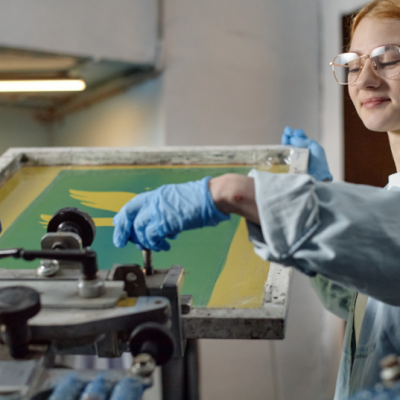
Screen printing remains a cornerstone of the feature, demonstrating why it still dominates high-volume garment work where opacity, hand-feel and cost per unit matter. Alongside it, digital textile printing shows its strengths in short runs, variable designs and rapid changeovers that analog methods struggle to match. By placing both side by side in a functioning workflow, Print Make Wear lets visitors judge not which technology is superior in the abstract, but which suits a specific business profile.
Pre-treatment and curing, often the unglamorous steps that determine whether a print survives washing, get proper attention in the live tour. Too many garment-decoration investments falter not on the printer but on the supporting processes, where inconsistent pre-treatment or under-curing produces failures that surface only after a customer complaint. Showing these steps as part of a continuous line reinforces that success depends on the whole system, not a single hero machine.
Finishing and embellishment round out the demonstration. Foiling, flock, transfer and other effects that add value to a finished garment are shown in context, illustrating how a decorator can move up the value chain from commodity prints toward premium, higher-margin products. For shops weighing where to invest, the feature makes the case that differentiation increasingly lives in what happens after the base print, in the layers of value a garment can carry.
The educational value extends beyond the machinery. Print Make Wear is typically staffed by specialists who can explain colour management, fabric behaviour and production planning in plain terms, turning a walk-through into a working seminar. For entrepreneurs entering garment decoration, or established printers diversifying out of flat-sheet work, that contextual knowledge is often the missing piece between buying equipment and running it profitably.
FESPA’s emphasis on a live, integrated demonstration also reflects the maturing of digital textile printing as a commercial proposition. Early adopters were often drawn by the novelty; today’s buyers are focused on throughput, reliability, ink cost and the unglamorous economics of running decoration as a business. By staging the entire workflow, the feature speaks directly to that more disciplined audience, which arrives with spreadsheets rather than curiosity alone.
For the broader print sector, Print Make Wear is a reminder that growth segments increasingly live at the intersection of disciplines. Garment decoration draws on screen, digital, chemistry, finishing and workflow software, and the businesses that thrive are those that master the combination rather than any single element. Events that show the combination in motion do more to advance adoption than any number of isolated product launches.
As FESPA expands the feature for 2026, the expectation is that more visitors will use it as a planning tool, mapping the demonstrated workflow onto their own operations and identifying where the gaps and opportunities lie. In a market where textile printing continues to attract new entrants, a clear, honest view of the full production chain is exactly the kind of practical education that helps the segment mature without costly missteps.
For suppliers, the feature is also a recruiting and education tool. Many garment-decoration businesses are run by entrepreneurs who started with a single press and learned by doing, and Print Make Wear exposes them to the full production chain they may one day need. Seeing pre-treatment, curing and finishing working in concert helps them plan capacity and avoid the false economy of buying a printer without the supporting process that makes it profitable in the long run.
The return of Print Make Wear also signals confidence in textile printing as a growth segment even as the wider print market contracts in places. Decorated apparel, sportswear, workwear and promotional textiles continue to attract new entrants, and live, honest demonstrations of the workflow help separate serious opportunity from overhyped expectation. As FESPA expands the feature for 2026, it is positioning the event not just as a showcase but as a practical on-ramp into a demanding but rewarding market.
Source: FESPA, published 2026.