 中文
中文Every printed product requires finishing, and in the wide-format and signage industries, the quality of finishing can determine whether a job delights the customer or results in costly reprints. As print service providers invest in increasingly sophisticated printing technology, the importance of matching finishing capabilities has never been greater. A beautifully printed graphic that is poorly cut or finished can undermine the entire value proposition of a print provider. Recognising this, FESPA has published a comprehensive guide to modern finishing technologies, covering everything from basic roll slitters to advanced CNC cutting tables and robotic automation.
The guide, authored by industry expert Nessan Cleary, emphasises that every single print job requires finishing, and that clean cutting is essential to prevent material waste. The cost of servicing and support, Cleary argues, is just as important as the upfront investment in the machine itself. A cutting table that delivers perfect cuts for six months but then requires frequent repairs can quickly become a liability rather than an asset.
At the most basic level, roll slitters remain a vital tool for many print service providers. These simple devices cut rolls down to the required width or cut rolls into sheets, handling materials including vinyl, banner, and textile materials. For vinyl graphics, hand-held vinyl slitters remain indispensable for trimming panels for vehicle graphics and other applications. While basic, these tools form the foundation of many finishing workflows.
Moving up in sophistication, cutting plotters (sometimes referred to as vinyl cutters) can cut out intricate shapes and are most commonly used with self-adhesive vinyl. The range of applications depends largely on the cutting force the device can deliver. Around 120g of cutting force is sufficient for paper and vinyl, suitable for producing stickers or cutting out lettering and shapes. For tougher materials such as reflective films, a more heavy-duty solution with up to 600g of cutting force is required. Most cutting plotters offer multiple cutting options, including cutting through the substrate, kiss cutting (cutting through the graphic layer but not the backing material), and perforating.
For print service providers primarily producing stickers, dedicated printer-cutters that integrate printing and cutting in a single device offer advantages in registration accuracy. However, for higher volume throughput, separate devices are often preferable since the two functions operate at different speeds. The choice between integrated and separated devices depends on the specific production requirements and volume expectations of the print service provider.
Digital cutting tables, sometimes referred to as CNC cutters, represent the next level of sophistication. These extremely versatile tools use Computer Numerical Control (CNC) systems to automatically position the cutting head with extreme precision, enabling the production of intricate cutting patterns that can be repeated consistently for multiple identical copies. They can handle a wide range of media, from vinyl and textiles to foamcore and cardboard. Some tables are optimised for specific applications such as packaging prototyping or textile production.
The market for cutting tables has become highly competitive in recent years, driven in large part by the emergence of capable Chinese vendors such as JWEI and iEcho. These companies have brought capable, cost-effective cutting tables to market, as evident at recent FESPA expos. In response, established Western manufacturers including Kongsberg, Zünd, and Elitron have focused on offering larger, more automated systems with advanced features.
A key consideration with cutting tables is overall productivity. Most manufacturers quote cutting speeds, but actual productivity is affected by the type of material, the complexity of cuts (particularly curves, which slow head movement), and the time required to load materials, locate reference points, and position the cutting head. To maximise throughput and prevent the cutting table from becoming a bottleneck, print service providers must carefully evaluate not just cutting speed but also material handling, software integration, and automation features.
CNC routers represent a further step up in capability. While often viewed as heavy-duty cutting tools, CNC routers are designed to cut through much thicker, denser materials including acrylic, plexiglass, plastics, wood, composites, and some non-ferrous metals. They use similar CNC systems to cutting tables but with more powerful spindles and more robust construction. Many cutting tables can be fitted with routing heads, and some vendors offer hybrid models capable of handling a very wide range of substrates. Beyond cutting, CNC routers can create dimensional signs, perform engraving, and operate at high speeds, opening up additional revenue streams for print service providers willing to diversify.
Modern cutting tables and routers typically offer three-axis movement as standard, positioning the cutting head anywhere along the width and length of the table and controlling cutting depth. Some advanced CNC routers offer up to five-axis movement, allowing the head to tilt or rotate for greater cutting angle flexibility. While not always necessary for signage, this capability can open up opportunities in industries such as mould making, prototyping, and industrial design.
Tooling is another critical consideration. Most large format service providers work with diverse materials, each requiring specific cutting tools to ensure clean cuts with sharp edges. Creasing wheels for fold lines (important for point-of-sale displays and packaging), drag knives for vinyl and thin materials, and router bits for thicker substrates are all part of a comprehensive tooling strategy. Most modern systems include automatic tool changing, reducing operator intervention between jobs.
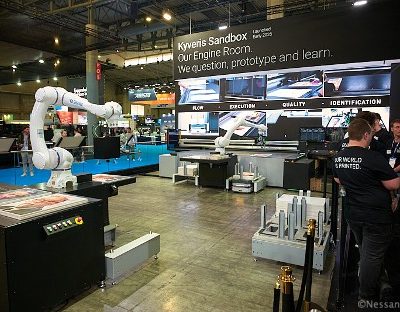
Perhaps the most significant trend in modern finishing is the increasing use of robotic automation. Robotic arms are being used with both CNC cutting tables and routers to automate material loading and unloading, increasing throughput and reducing labour costs. In theory, this allows one operator to oversee several automated production processes, improving overall equipment effectiveness.
Finally, software integration is essential. Cutting devices should integrate with workflow software so that cutting patterns can be set up alongside prepress preparation. Most modern cutting and routing systems include sophisticated software, but keeping it updated through maintenance or licensing contracts is increasingly important as features and capabilities evolve.
As the printing industry continues to evolve, finishing capabilities will remain a key differentiator. Print service providers that invest in the right combination of cutting technology, automation, and software integration will be best positioned to deliver high-quality results efficiently and profitably.
Source: FESPA