
 中文
中文On May 29, an event titled "Intelligent Computing Future – Rolling Optimization Special Computing Chip Innovation Forum" was held grandly at Tongji University. At this forum, Chen Hong, a professor at Tongji University's School of Electronics and Information Engineering and School of Automotive and Energy's Intelligent Vehicle Research Institute, released the first-generation rolling optimization special computing chip independently developed by his team, which is the Moving Horizon Unit, or MHU for short. On that day, all the guests attending the meeting were at Tongji University's Intelligent Connected Vehicle Testing and Evaluation Base. We observed on-site the operation demonstration of a real vehicle equipped with this chip in various scenarios such as snaking and changing lanes.

Run the demo. Photo courtesy of Tongji University, the same below
As the era of embodied intelligence approaches, in response to its computing needs of "strong real-time, deep prediction, and low power consumption," Chen Hong's team has relied on the technology accumulated in the direction of "algorithm hardwareization" over the past 30 years to create a dedicated computing architecture that can perform rolling optimization and has completely independent intellectual property rights.
Chen Hong said that rolling optimization is an innate ability of human beings. People do not plan all paths to the end at once. Instead, they continuously adjust their behavior based on the current status and external feedback, and move closer to the goal step by step. Autonomous equipment such as self-driving vehicles, intelligent robots, and drones are often in complex and changing environments. They must continuously sense external changes, dynamically plan action paths, and complete decision-making control in real time. This kind of continuous dynamic and strong real-time computing tasks is an important challenge faced by general-purpose chips.
The work carried out by Chen Hong's team is to transform the mechanism with rolling optimization characteristics of "see one step, think a few steps, take one step, and then adjust" into dedicated computing capabilities that can be executed by machines and carried by chips in response to environmental changes and uncertainties. By moving key links such as prediction, optimization and control to the bottom layer of the hardware in advance, relevant equipment can complete planning and decision-making based on environmental changes without completely relying on preset fixed procedures.
It is understood that this architecture has achieved three underlying innovations. The first one is "accurate calculation", which is to embed the prediction and optimization capabilities of the physical world into the bottom layer of the hardware, so that the equipment can dynamically plan for the future state; the second one is "fast learning", by integrating AI algorithms and real physical laws, reducing the machine's dependence on massive data; the third one is "keeping the bottom line", directly embedding hard constraints in the bottom layer of computing, and building a reliable "safety protection fence" for autonomous unmanned systems.
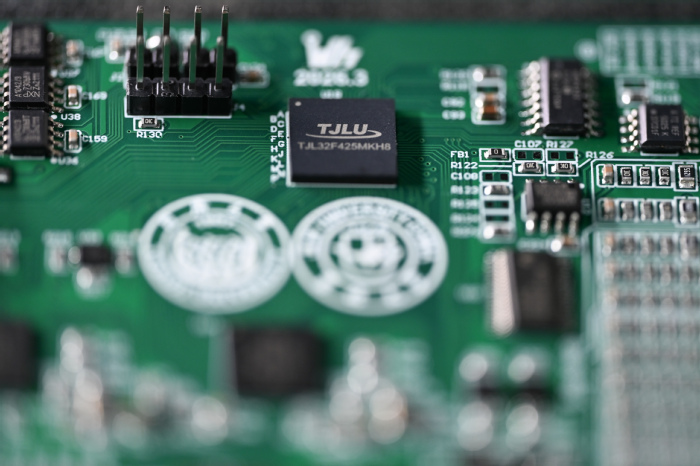
The first generation of dedicated computing chips for rolling optimization.
During the process of chip research and development, the team also explored a technical approach that combined "specialized customization" and "universal embedding". Its computing core module for rolling optimization can not only adapt algorithms according to different application scenarios, but also can be used as a general module to cut into multiple types of chip systems across platforms, achieving a transition from dedicated computing to the bottom layer of general integration.
Chen Hong introduced that the first-generation rolling optimization dedicated computing chip has completed actual vehicle verification in an intelligent vehicle control scenario, preliminarily proving its technical feasibility. In the future, the team will continue to promote chip iterative upgrades, deepen joint research and development with the industry, accelerate the application process of chips in intelligent manufacturing, industrial control, new energy, robotics and other fields, empower more independent equipment to achieve core tasks such as dynamic prediction, game decision-making and planning control, and inject strong underlying driving force into the high-quality development of intelligent transportation and high-end intelligent equipment industries.
Link: https://news.sciencenet.cn/htmlnews/2026/5/565703.shtm